The short version · By Austin Kerr · Updated
- Cabernet Sauvignon is the offspring of Cabernet Franc and Sauvignon Blanc. Researchers at UC Davis published the DNA evidence in 1997.
- The green bell pepper smell in Cabernet Franc comes from IBMP, a methoxypyrazine that tasters notice in red wine at around 15 parts per trillion.
- Plant scientists suspect IBMP is a warning that keeps unripe fruit from being eaten. It peaks two to three weeks before the grapes change color, then falls.
- In a Cornell study, shaded Cabernet Franc clusters built up more IBMP than sunlit clusters on the same vine.
- Our 2023 and 2024 Cabernet Franc come from the same vineyard near Paicines, California. Sunshine from April through October was almost even: about 2,711 hours in 2023 and 2,718 in 2024.
- The 2024 Cabernet Franc releases Sunday, December 20, from noon until 6 p.m. at 417 East Main Street in Fredericksburg.
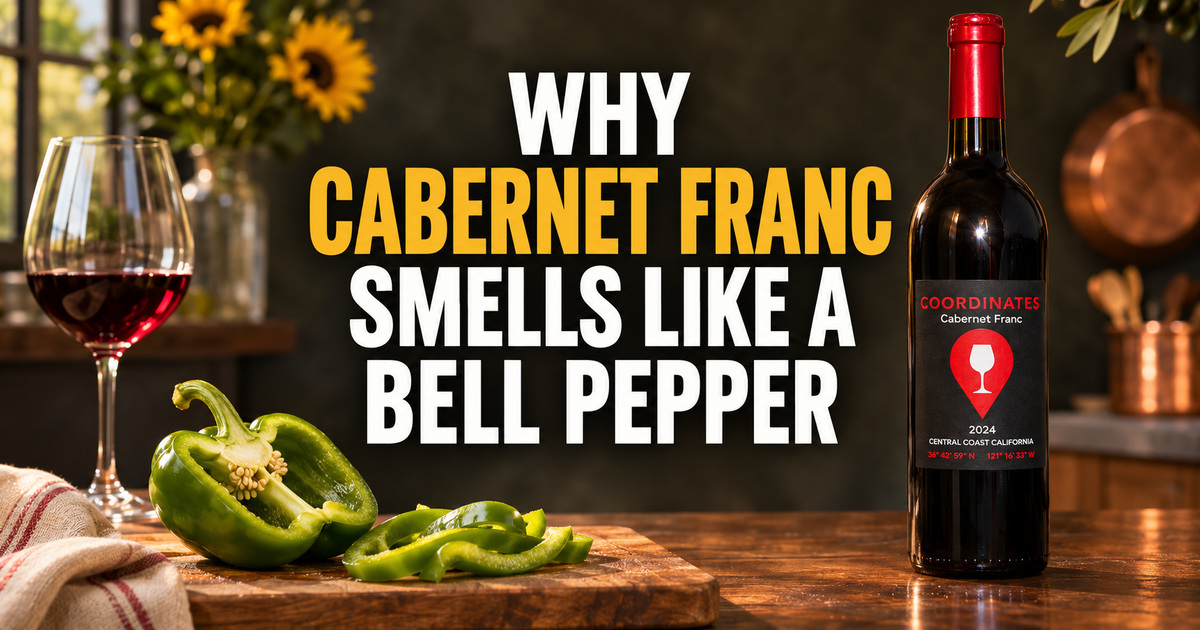
Our 2023 Cabernet Franc smells like dark berries. The 2024 from the same vineyard takes me straight to a green pepper on my cutting board. I thought I knew which vintage got more sunshine.
If you’ve ever ordered a Cabernet Sauvignon at a steakhouse, you were drinking Cabernet Franc’s kid.
And the other parent? Sauvignon Blanc. Yes, the white one.
In 1997, researchers at UC Davis published the DNA evidence. I like to picture those two wines sitting on a restaurant table. Somebody ordered the Sauvignon Blanc with oysters. Somebody else is waiting on a ribeye. What are the odds either of them looks across the table and thinks, family resemblance? Once you know, the names are almost too obvious. Cabernet Franc. Sauvignon Blanc. Cabernet Sauvignon.
In wine terms, Cabernet Sauvignon is the nepo-baby, with a name that opens doors on every steakhouse list in America. Cabernet Franc is the parent who made the whole career possible and rarely gets top billing.
It happens at our place, too. Back in October, a club member ordered two bottles of our 2019 Reserve Cabernet Sauvignon. Somebody on our team said, “Grab me two bottles of the Cab,” and two bottles of our 2023 Cabernet Franc went straight into the box. We only found out when they called, worried about the price difference and wanting to pay for what they got. We wouldn’t accept that. It was our mistake, and I doubt it’s the first time in history it’s been made.
That’s quite a family. Which brings me to the parent on our side of the bar. Our 2023 Cabernet Franc won Double Gold in both Houston and San Antonio. In that wine, I get dark berry fruit first. In the 2024 we’re releasing this December, I pick up fresh green bell pepper right out of the gate, with red and black berries, herbs and spice behind it. Same grape. Same vineyard. If you’d asked me which year got more sun, I’d have put my money on 2023.
So I looked.
Two minutes a day
Our Cabernet Franc grows at 36°42′59″N, 121°16′33″W, just north of Paicines in California’s San Benito County. If those coordinates look familiar, that’s where our Pinot Grigio grows, too.
I pulled Open-Meteo’s daily sunshine estimates for the area around the vineyard and added up the hours from April through October in both years. The 2023 season came in at about 2,711 hours of bright sunshine. The 2024 season came in at 2,718. Almost even. Spread that difference over seven months and you get about two extra minutes a day. In 2024.
I’d have lost the bet.
| 2023 Cabernet Franc | 2024 Cabernet Franc | |
|---|---|---|
| Bright sunshine, April through October | About 2,711 hours | About 2,718 hours |
| What hits the nose first | Dark berry fruit | Fresh green bell pepper |
| Where it stands | Double Gold in Houston and San Antonio | Releasing December 20 |
Growers one valley over in Monterey County remember those two years very differently. In 2023, a cool spring and summer stalled ripening so long that when the county’s growers association announced the first pick of the year, the headline ended with one word: “Finally!” The 2024 season ran the other way, opening with a wet, cool spring before stretches of heat in the middle and later parts of the season.
A sunny day and a warm day are different things. The sunshine total wasn’t going to settle it. So I went back to the smell.
The “don’t eat me” molecule
Next time you’re cutting up a green bell pepper, take a second when you lift the stem away. That smell rising off the cutting board is the one I mean. It comes from a family of aroma compounds called methoxypyrazines, and from one in particular, mercifully shortened to IBMP. In red wine, tasters start to notice it at around 15 parts per trillion. That’s roughly one drop in an Olympic swimming pool.
Why would a grapevine make it? A grapevine doesn’t grow sweet fruit for winemakers. It grows fruit to bribe birds into swallowing its seeds and flying away to plant them somewhere else. There is one catch. If a bird eats the berry before the seeds are ready, the trip is wasted. Plant scientists suspect IBMP is the vine’s warning, a keep-out sign on unripe fruit.
The timing fits the theory. IBMP builds up while the berries are small, hard and green. It peaks two to three weeks before they change color, and it falls from there as the sugar comes in.
Here’s where the family comes back in. If you’ve ever caught a whiff of green pepper in a Sauvignon Blanc, you’ve met IBMP on the other side of the family. Cabernet Franc carries it. And their kid got it from both sides.
What a leaf can do
Even on a sunny day, what matters most is what’s happening a few inches above the grape cluster.
Cornell researchers followed Cabernet Franc clusters through a growing season. They compared bunches on the very same vine, some exposed to sunlight and others tucked under leaves. Early on, while the berries were still green, the shaded fruit built up more IBMP. Later, as the grapes ripened, levels fell at about the same rate in both groups. The difference was already there while the berries were small. The highest levels of all turned up in shaded berries on the most vigorous vines.
I keep coming back to those two bunches. They shared the same soil, the same roots and the same weather report right down to the hour. A few leaves were enough to give them different summers.
That’s as far as I’d take the comparison to our vineyard. Weather data can count the hours of bright sun over Paicines. It can’t tell me which bunches spent June tucked under a leaf. For that last part, all I’ve got is what’s in my glass.
A first pour on Main Street
On Sunday, December 20, we’re releasing our 2024 Cabernet Franc at the Coordinates tasting room in the old blacksmith shop at 417 East Main Street in Fredericksburg. The release tasting runs from noon until 6 p.m.
If Cabernet Sauvignon is your usual steakhouse order, come meet the parent. And when you get your glass, give it a swirl and a smell before you ask me what I get. I’ve already told you about my cutting board. I’d love to hear where the wine takes you.
Frequently asked questions
Why does Cabernet Franc smell like bell pepper?
The smell comes from IBMP, one of a family of aroma compounds called methoxypyrazines. It is the same smell that rises off a fresh-cut green bell pepper. In red wine, tasters start to notice IBMP at around 15 parts per trillion, which is roughly one drop in an Olympic swimming pool.
Is a bell pepper smell in Cabernet Franc a flaw?
It is a natural compound in the grape, not a winemaking fault. How much of it shows in the glass depends on the vineyard and the season. In our 2024 Cabernet Franc, the green bell pepper comes with red and black berries, herbs and spice behind it.
What grapes are Cabernet Sauvignon’s parents?
Cabernet Sauvignon is the offspring of Cabernet Franc and Sauvignon Blanc. Researchers at UC Davis published the DNA evidence in 1997.
Why would a grapevine make a bell pepper smell?
Plant scientists suspect IBMP is a warning that keeps unripe fruit from being eaten before the seeds are ready. The timing fits. IBMP builds up while the berries are small, hard and green, peaks two to three weeks before they change color, and falls as the sugar comes in.
Does shade make Cabernet Franc smell more like bell pepper?
It can. Cornell researchers compared shaded and sunlit Cabernet Franc clusters on the same vines through a growing season. Early on, while the berries were still green, the shaded fruit built up more IBMP. As the grapes ripened, levels fell at about the same rate in both groups. The highest levels turned up in shaded berries on the most vigorous vines.
Did the sunnier vintage smell less like bell pepper?
No. Open-Meteo’s regional estimates put April through October at about 2,711 hours of bright sunshine in 2023 and about 2,718 hours in 2024, almost even. The 2024 is the vintage that leads with green bell pepper. A sunshine total for the area cannot show how much shade individual grape clusters had.
Where does Coordinates Vineyards’ Cabernet Franc come from?
Our Cabernet Franc is from the Central Coast of California, near Paicines in San Benito County. The coordinates on the 2024 label are 36°42′59″N, 121°16′33″W. The 2023 vintage won Double Gold in both Houston and San Antonio.
Where can I taste Cabernet Franc in Fredericksburg, Texas?
Coordinates Vineyards releases its 2024 Cabernet Franc on Sunday, December 20, 2026, from noon until 6 p.m. at the tasting room at 417 East Main Street in Fredericksburg. See the release party details or reserve a tasting at Main Street or at the vineyard farmhouse in Hye.