How a muddy road, a winemaker in Paarl, and one South African red led us to our name.
By Austin Kerr, co-owner, Coordinates Vineyards
We called Robert because Anton’s Honda Civic was stuck in a vineyard.
“Where are you?”
We could not answer that question.
It had been raining. The road we needed appeared to run parallel to the road we were on, with only vineyards between us. At some point, a tractor path had looked like a reasonable way to get across.
Anton’s 1994 Honda Civic disagreed.
The tires spun in wet clay. I got out to push and was rewarded with mud all over me. Anton climbed out in his suit to help, which became considerably funnier when one of his dress shoes came apart.
We were trying to find a winemaker in Paarl, South Africa, and it was not going well.
Luckily, Robert had recently had the property surveyed. Instead of trying to establish which tractor path we had mistaken for a road, he sent the GPS coordinates of his house.
We entered the numbers, which I didn’t know was possible until that moment, and it turns out we were just five minutes away. We shoved branches from the dormant vines under the tires, got the Civic free and arrived in no time. Robert helped duct tape Anton’s shoe back together. Then we stood at his kitchen counter with biltong between us and tasted wine.
Years later, when my brother Mahlon and I were trying to name our winery in Texas, everything would come back to those numbers.
Somebody knew somebody
At the time, I had been living in Taiwan and trying to build a small wine-import business into China. South Africa had brought me wines I wanted to work with, but finding good wine and finding wine you can build a business around are different jobs.
Many of the obvious wineries already had established distributors. Their properties were beautiful, their wines were good, and somebody else had already had my idea. I could not build much of a business by being the smallest person fighting for the most obvious bottles.
The wines I wanted often came through people. Somebody knew somebody, and in this case that somebody was Anton. He told me I needed to meet Robert Frater, whose family had been farming grapes in Paarl for generations.
That recommendation was enough to get us into the Civic, though getting us out of it required a bit more work.
Robert’s operation was not built around polished wine tourism. At his kitchen counter, there was no tasting sheet telling me what I should find. There were not even labels on the bottles. Everything about that moment felt special, and I had no idea at the time, that it was the start of the journey that would eventually lead to Coordinates Vineyards.
His Pinotage became part of the wines I brought into the business. The coordinates he sent became the first in a system I kept using as I found other producers.
A set of numbers was useful when an address was not. I kept them in my phone. I did not know I was also keeping the name of a winery.
The answer in my phone
When Mahlon and I began planning the winery we would open in Texas, South African wine was already part of the business we wanted to build. It came with people attached.
When we needed a name, there was only one choice:
Coordinates.
The name came from finding our way to people whose wines we wanted to share. It also left room for wherever we might go next. We could make wine in Texas, bring wines from South Africa and California, and tell people how each one found its way to the table.
Pinotage became our best-selling wine. It is what Coordinates is known for. But before it was a favorite in our tasting rooms, it was a wine I had found through a friend who thought I should meet somebody.
What is Pinotage?
Pinotage is a red wine grape created in South Africa by crossing Pinot Noir with Cinsaut. Professor Abraham Izak Perold made the cross at Stellenbosch University in 1924 and planted the resulting seeds in 1925. Cinsaut was known locally as Hermitage, which supplied the second half of the name.
It is its own grape variety. Blending Pinot Noir and Cinsaut in a tank will not give you Pinotage.
Most red Pinotage is dry. In the wines I work with, I often find dark plum, blackberry or black cherry, with spice and something savory. Sometimes there is smoke or dried herbs. In some glasses, I find rooibos, the South African red bush tea.
Do not let the Pinot Noir connection set your expectations too firmly. Pinotage can make substantial reds that may appeal to someone who enjoys Syrah or Zinfandel. It can also be lighter and fresher. The producer matters, as do the vineyard and the decisions made between picking the grapes and opening the bottle.
That variety is part of the attraction. There is more than one way to enjoy Pinotage, and more than one bottle worth getting to know.
Four seeds and someone who remembered them
Perold’s experiment produced just four seeds.
After he left the university, the young plants were nearly lost. A young academic named Charlie Niehaus rescued them during a cleanup at Welgevallen farm and helped ensure their survival. Before Pinotage had a reputation, it needed somebody who remembered where it had been planted.
The reputation, when it came, was complicated. A Bellevue Pinotage won the General Smuts Trophy in 1959. Yes, that’s actually his name. In 1976, visiting Masters of Wine dismissed the variety as having “no future.”
Perhaps they tasted bad wine. Nobody owes a bad bottle admiration because the grape has an interesting history.
The unfairness came when disappointment with a bottle became a verdict on the variety. A bad Cabernet was evidence that somebody had made a bad Cabernet. A bad Pinotage somehow became evidence that Pinotage itself was bad.
Winemakers kept working with it anyway. Beyers Truter became one of its most important champions at Kanonkop, earning the International Winemaker of the Year award in 1991 for his 1989 Pinotage.
I like that the history contains both doubt and persistence. People kept growing the grape and making wine while its reputation went up and down. Eventually, their work gave someone else a reason to try it. And today, South Africa is producing lots of world class Pinotage.
Bringing Pinotage home to Texas
We did not set out to become Pinotage specialists. We followed relationships, and the people we trusted kept leading us back to the grape. Across the Pinotages we have brought to Texas, our guests have kept choosing it, again and again.
Most customers arrive having never heard of Pinotage. Others tried a bottle years ago and decided they knew what it tasted like. I enjoy pouring for both, because neither conversation can go very far until there is wine in the glass.
You may like the first one we pour. You may prefer a different style. Either gives us something useful to talk about. We can find out whether you enjoy a fuller wine, something fresher, or the way a particular bottle changes as you sit with it.
That is part of why I wanted to bring these wines home. The introduction does not end when a bottle arrives from South Africa. Someone still has to open it, pour it and give another person a chance to decide.
Robert did that for me at his kitchen counter. At Coordinates, we get to do it every day. And now that we have been pouring Pinotage in Texas for four years, we have something really special planned for this November.
Come taste Pinotage in Fredericksburg or Hye
You do not need to know the grape’s history to enjoy it. But I like knowing that a bottle can lead back through the people who made it, the person who introduced us, and a road we probably should not have taken.
Come taste South African Pinotage at our Main Street tasting room in Fredericksburg or our Vineyard Farmhouse in Hye. Tell us you came for Pinotage, and let us introduce you to the wine that helped bring Coordinates into being.
- Fredericksburg: 417 East Main Street. Reserve your Main Street wine tasting.
- Hye: 10120 US Highway 290 West. Reserve your Vineyard Farmhouse wine tasting.
If you are looking for a bottle to take home, explore our 2021 Pinotage, our best-selling wine to date. You can also learn about our upcoming 2020 Reserve Pinotage or browse our current red wines. Learn more about Pinotage in Texas here.
The first time I went looking for Robert, I arrived covered in mud. You can arrive with a reservation. But, we don’t mind, we will be glad to see you either way.
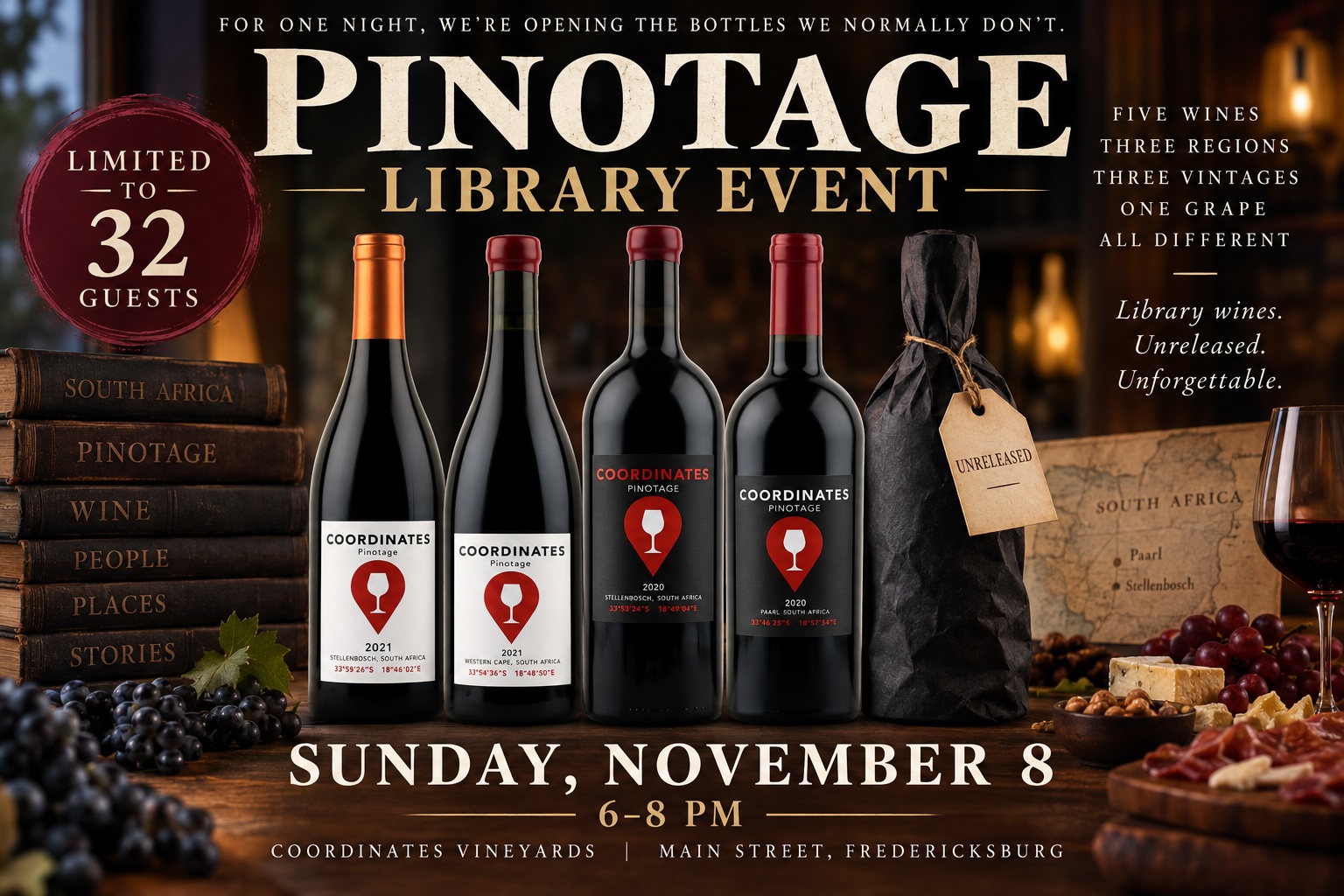
Taste five Pinotages with us on November 8
Sunday, November 8, 2026 | 6–8 p.m.
Coordinates Vineyards | Main Street, Fredericksburg
Limited to 32 tickets
For one night, we’re opening the bottles we normally don’t. Join us for an intimate comparative tasting of five South African Pinotages, including library wines, wines tied to the people and places that shaped Coordinates, and one wine that has not yet been released.
Library wines are bottles held back from earlier releases. Our library Pinotages are reserved for special tasting events, giving us a chance to explore different producers and older releases together. On November 8, we’ll taste all five wines side by side.
View the five-wine lineup and get your Pinotage Library Tasting tickets.
Read next
For another South African wine story, read The Grape France Came Back For, our article about Chenin Blanc and the vineyards that preserved something France had lost.
Planning a visit? Explore our guide to Pinotage in Texas and see the tasting options at both Coordinates locations.
Frequently asked questions
What is Pinotage?
Pinotage is a South African red grape created by crossing Pinot Noir with Cinsaut. It is a distinct grape variety, not a blend of wines made from its parents.
Is Pinotage sweet or dry?
Most red Pinotage is dry. Ripe fruit aromas can suggest sweetness without the wine tasting sugary.
Does Pinotage taste like Pinot Noir?
Not necessarily. Pinotage can make much fuller, darker wines than the Pinot Noir connection might suggest, although lighter styles also exist.
Where can I taste Pinotage in Texas?
Coordinates Vineyards pours South African Pinotage at our tasting rooms in Fredericksburg and Hye. Book a tasting on Main Street in Fredericksburg or reserve a tasting at our Vineyard Farmhouse in Hye.
Can I buy Coordinates Pinotage?
You can purchase wine at our tasting rooms or shop our 2021 Pinotage online. Visit our red wine collection for current offerings and availability.
What are library Pinotages?
Library wines are bottles held back from earlier releases. Our library Pinotages are reserved for special tasting events rather than everyday retail availability. The November 8, 2026 Pinotage Library Tasting brings five South African Pinotages together at our Main Street tasting room from 6–8 p.m., with just 32 tickets available for the event. You can also check our events page for upcoming tastings.
Sources and further reading
The personal experiences in this article are my own. These references support the grape’s history and range of wine styles.
- Pinotage Association: Heritage. The survival of the early plants, the General Smuts Trophy, the 1976 criticism and Pinotage’s subsequent development.
- Wine & Spirit Education Trust: Polarising Pinotage: The Famous South African Grape Re-examined, by Malu Lambert, October 10, 2024. The 1924 cross and 1925 planting, Pinotage’s parentage and stylistic range, and Beyers Truter’s international recognition.