One vine, a mutation that keeps happening, and a decision made at the press.
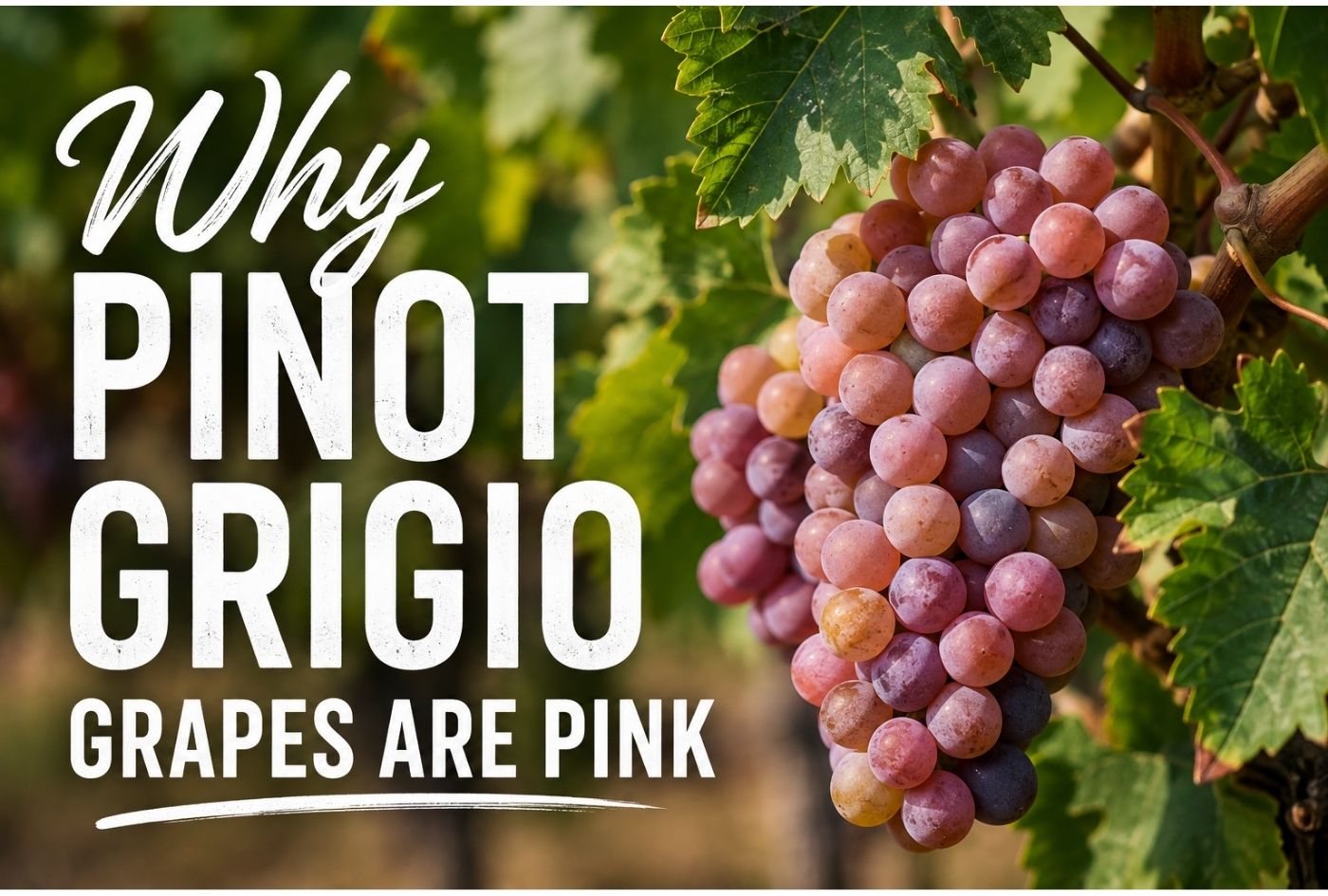
A week before harvest, a Pinot Grigio cluster does not look like it belongs in a white wine. The berries come in gray, bronze, dusty rose, sometimes close to lavender, and usually several of those colors on the same bunch.
Press them and the juice runs nearly clear.
The mechanical explanation is simple enough. Almost all of a grape’s color lives in the skin, not the pulp. Press gently, pull the juice off the skins right away, and you get a pale wine no matter what the fruit looked like on the vine.
Leave that same juice on the pink skins for a few hours and it turns copper. Northeastern Italy has been making that version for a long time and calls it ramato, Italian for coppery. Before fast presses and refrigeration, some skin contact was difficult to avoid, and a Pinot Grigio with color in it was closer to normal than not. The water-clear version most people picture is the newer idea.
The pink color of the grapes is the harder story to explain.
A grape that is never finished
Pinot Grigio is not a separate variety the way Cabernet and Merlot are separate varieties.
It is Pinot Noir, altered.
A vine does not change all at once. A single bud on a single cane mutates, and the shoot growing out of that bud carries fruit unlike anything else on the plant. For the change to survive, a grower has to notice it during the season, mark the cane, take dormant cuttings that winter, and propagate them separately. Miss it and the whole thing goes into the burn pile in February.
Pinot Noir is unusually good at producing those buds. It is one of the oldest cultivated varieties, which has given it a very long time to accumulate mutations, and a disproportionate number of those have landed on the small cluster of genes that control berry color.
A grape skin is built in layers of cells, and researchers describe Pinot Grigio as a chimera: the outer layer carries the mutation that shut down most pigment production, while the layer underneath still carries working color genes. The patchy gray and pink you see in the vineyard is the disagreement between them, and because it responds to the season, the same block can look bronze one year and closer to rose the next.
A Pinot Grigio vine will occasionally throw a cluster of entirely white-skinned berries, or a single bunch split down the middle, colored on one side and pale on the other.
Which brings up something most wine writing gets wrong, and which the scientific literature got wrong too until fairly recently. The standard account has Pinot Blanc descending from Pinot Grigio, one vine losing its color in tidy stages. A 2012 study that mapped the color locus across dozens of Pinot clones concluded otherwise. Pinot Blanc and Pinot Grigio appear to have arisen independently, as separate mutations of Pinot Noir.
Not a sequence. The same accident, twice.
What I missed for about thirty years
I grew up in Oregon, where they use the French name, Pinot Gris. Pinot Noir and Pinot Gris are all over the state, on every list, in every grocery store, and I never once wondered why those two particular grapes ended up sharing the same coordinates. I assumed it was fashion, or coincidence, or that somebody planted a white because you need a white.
The trail leads back to one man.
In January 1965, a twenty-five-year-old named David Lett went north with a theory his professors at UC Davis had told him was wrong: that the Willamette Valley was cold enough to ripen Pinot Noir the way Burgundy does, barely, in the good years. The cuttings came out of the Davis test nursery. He took three thousand of them and towed them behind an old Volvo up to Oregon.
He was not going north to plant two grapes. He brought a spread of them, Chardonnay and Riesling and Gewürztraminer among others, because nobody knew yet what would work up there. Pinot Noir was the one he cared about. Pinot Gris was an experiment, and as far as anyone can tell it had never been planted in this country outside a research collection.
Nothing in the record says why he picked it, and I am not going to invent a reason. What the record shows is which experiments stuck. Sixty years on, Oregon’s two leading grapes are Pinot Noir and Pinot Gris.
They sit side by side on every shelf in the state, a red and a white, and they are the same plant.
I grew up there and never knew it.
The names it collected
Here I have to separate what is documented from what simply gets repeated.
The familiar account has Cistercian monks carrying Pinot Grigio out of Burgundy into central Europe in the thirteenth and fourteenth centuries. It is plausible. The monastic orders did move vine material across long distances, and the grape did end up everywhere they went. But the paper trail is thin and I would not treat the dates as settled. Old vines have a way of acquiring tidy origin stories after the fact.
The German chapter is better documented, and it is my favorite.
In 1711, a merchant in Speyer named Johann Seger Ruland came into an abandoned garden and found vines in it that nobody could identify. He picked the fruit, pressed it, liked the wine enough to propagate cuttings, and the grape carried his name from then on. Germans still call it Ruländer.
That nobody could place it is less strange than it sounds. Until the fruit colors up, Pinot Grigio is very difficult to tell apart from Pinot Noir or Pinot Blanc. The leaves match. The clusters match. Ripe berry color and ripening date are most of what separates them, which is another way of saying it is the same plant wearing a different coat.
When anyone finally connected those vines back to Burgundy, I cannot tell you. Every account I have found says the vine was later discovered to be Pinot Gris and leaves it at that, with no date attached. By the time DNA work put the question beyond argument, the German name had been in use for the better part of three centuries.
There is a wrinkle worth knowing if you ever shop German whites. Ruländer and Grauburgunder are both Pinot Grigio, and German wine law recognizes both names for the same grape, because they signal different intentions. Grauburgunder means dry and taut. Ruländer means riper, rounder, often sweet. Same vine, two decisions at the winery, two words on the bottle.
The 1961 decision
Santa Margherita, in Italy, is generally credited with putting the pale style into the world in 1961, though the company dates its own change to 1960. Press gently, separate the juice from the skins immediately, keep everything cold and moving, and bottle a wine built entirely around freshness and aromatics rather than color or weight.
Where that idea came from is the part usually left out.
Santa Margherita had been making sparkling wine since 1952. Getting a pale base wine out of dark-skinned fruit is a routine problem in sparkling production and it has one solution: press gently and quickly, and get the juice away from the skins before the color moves. Champagne has been doing it with Pinot Noir for centuries. Santa Margherita took a technique built for bubbles, applied it to a still wine, and the grape they applied it to was Pinot Noir all along.
Americans got it almost twenty years later, through one importer on a specific errand. In 1979, Anthony Terlato was traveling Italy looking for what he called the next great white wine. He tasted a Pinot Grigio in a Milan hotel, changed his travel plans, and drove to Portogruaro. At a restaurant there he ordered every Pinot Grigio on the list, eighteen bottles, and worked through them with the owner. Santa Margherita was the one.
For a generation after Terlato’s bet, Pinot Grigio was not an Italian white wine in America. It was the Italian white wine.
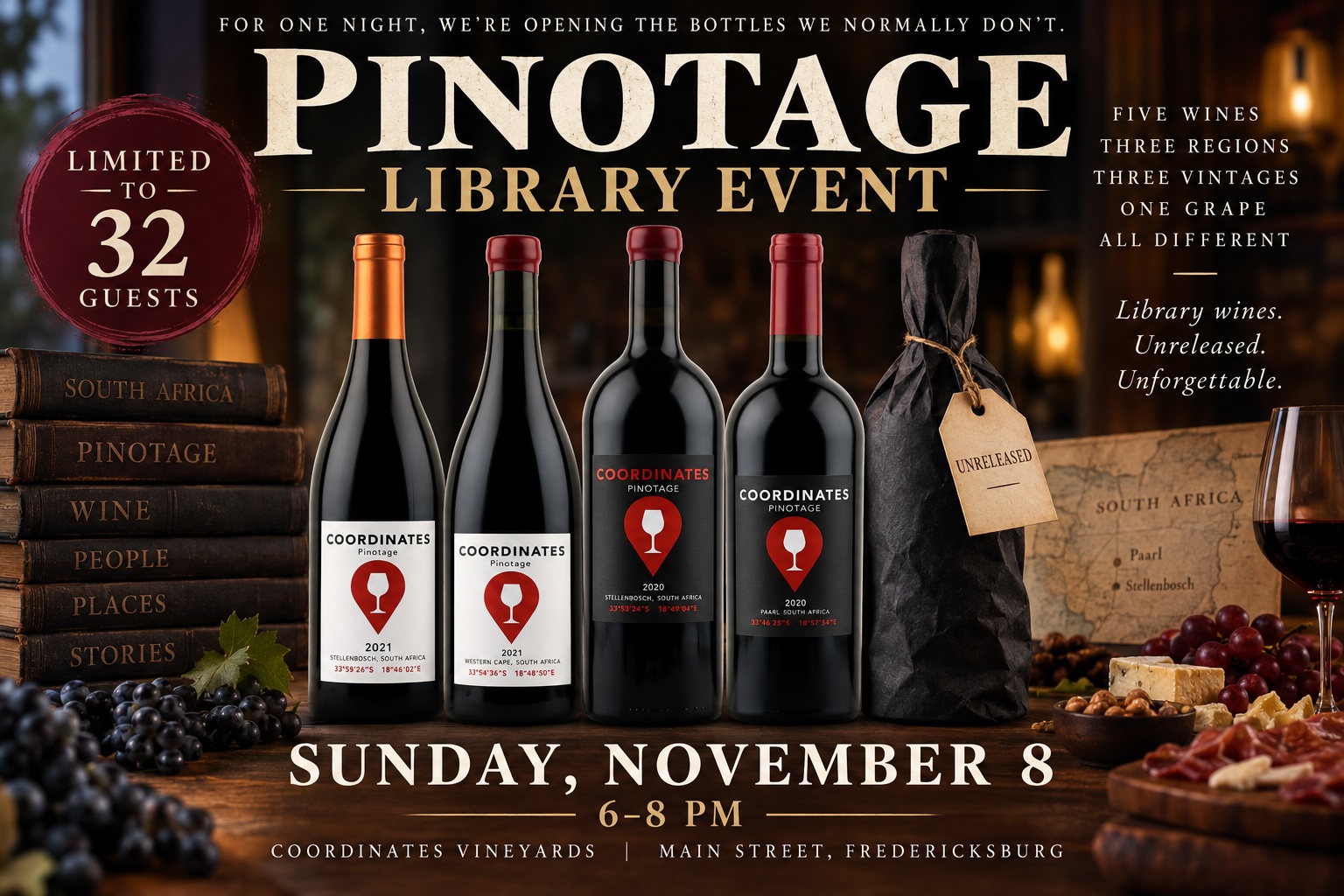
This story reminds me so much of my own beginnings, stuck in the mud searching for the first wine to import to China and finding Pinotage at a kitchen table in Paarl.
36°44’33”N, 121°16’01”W
That is where our Pinot Grigio fruit grows. Just north of the town of Paicines, in San Benito County, about twelve miles south of Hollister.
Pinot Grigio lives on acidity, and heat burns off acidity. So the whole question with this grape is whether a site can deliver enough warmth to ripen the fruit without cooking the freshness out of it, which usually means looking for somewhere that gets genuinely cold after dark.
Paicines is, on paper, the warmest of San Benito County’s appellations, mostly because it sits low. That should be a problem, but it is not, because of what happens at night.
Monterey Bay sits about thirty-five miles west, and the water there is startlingly cold for California. Cold enough to grow kelp forests and to make swimming in August a wetsuit proposition. That cold is not a matter of latitude. Prevailing winds push the warm surface layer offshore and deep water rises to replace it, and the upwelling chills the air sitting above it. In the afternoon, as the inland valleys heat up and their air rises, that cold marine air gets pulled through the gaps in the hills and funneled down the valley.
Paicines sits on an exposed valley floor, so the wind arrives with nothing to slow it down. Fog rarely settles there, which matters more than it sounds. Cold coastal air usually arrives wet, and wet nights on a tight-clustered grape mean rot. Here the fruit gets full sun through the day and cold wind after dark without the moisture that normally rides along with it.
The soils are sandy, with gravel and limestone running through them, which drains fast and sends roots down deep.
I have a selfish reason to like that piece of geography. One of my favorite childhood memories is of the Monterey Bay Aquarium, which exists because that bay is cold and strange and full of things that need cold water to live. The same upwelling that fills those aquarium tanks is what cools our fruit at night.
Two presses
Our fruit came in and went to the press in two fractions.
The first ran at two tenths to eight tenths of a bar, which is barely pressure at all. Mostly the weight of the fruit on itself and a gentle squeeze after. That juice is the aromatic one, high in acid, all citrus and top notes, and if you have read this far you know exactly whose technique that is. It is the 1961 decision. It is also what happens in the press house of every traditional method sparkling producer on earth, where the first, softest fraction gets kept separate because it is the cleanest thing the fruit will give you.
The second fraction ran from eight tenths up to one and eight tenths of a bar. Harder. That is where the skins start to give up more than juice.
This is the part I find genuinely interesting, having spent the last few thousand words on pink grapes. Pressing harder on a pink-skinned variety pulls more phenolic material out of the skin. Not enough to turn the wine copper, but enough to change how it feels. Weight across the middle of the palate. Something to hold onto. The second fraction is a step in the direction of ramato and stops well short of it.
So the two lots were not two vineyards or two clones. Same fruit, same day, same press. The only variable was how hard we squeezed, and it produced two wines different enough to ferment separately and argue about later.
They went into oak, ten percent new French and ninety percent neutral French barrels that have already given up whatever they had to give. The neutral wood is not there for flavor. It is there because barrels breathe and stainless does not, and a small amount of oxygen exchange builds texture without leaving a taste behind. The ten percent new is the only part doing anything you could point at, and the reason it is ten and not thirty is that this grape has a narrow tolerance for it. Push oak into Pinot Grigio and the citrus goes first.
The final blend came out almost even, tilted toward brightness.
Finished at 3.37 pH with 6.8 grams of acid, which are numbers I would happily put on the label if anyone read labels that way. Both sit where a white wine wants to sit when it needs to stay awake through a Texas August.
The new reputation
Pinot Grigio spent the 1980s and 1990s being punished for its own popularity. Demand went vertical and a lot of vineyards responded the way anyone would, with more fruit per vine, earlier picks and bigger volumes. A vine has only so much to give in a season. Ask it to fill twice as much fruit and something gets thinner, and it is the part you taste. Two decades of that, and Pinot Grigio came to mean the thing you order when you do not care what you are drinking.
None of it was the grape’s fault. It was a farming decision, repeated at scale.
The bottles worth drinking now come from people doing less. Lower crop loads, more selective picking, less done to the wine afterward. Nothing exotic. Just the ordinary attention any variety needs, which this one stopped getting for a while.
What is actually in the glass
Go back to that cluster in the week before harvest. Gray, bronze, dusty rose, several colors on one bunch, and no two seasons quite alike.
None of that is decoration. It is a record. A bud mutated and somebody noticed. An outer layer of cells quit making pigment while the layer beneath it kept working. The same accident happened twice, independently, and produced a second white grape from a black one. Everything after that is a decision made at the press: leave the color in and the wine comes out copper, take it out fast and you get the wine America has been drinking for forty years.
The vine underneath all of it is Pinot Noir. It kept the thin skins, the early ripening, the habit of reporting on exactly where it was grown and how carefully it was handled.
Our 2025 Pinot Grigio comes off that Paicines fruit. Citrus, green apple and pear, dry, with a mineral edge and a little more weight through the middle than most. We pour it in both the Fredericksburg and Hye tasting rooms.
Pinot Grigio FAQ
Is Pinot Grigio the same grape as Pinot Gris?
Yes. The names signal style rather than variety. Pinot Grigio suggests the lighter, crisper Italian approach; Pinot Gris the richer, fuller Alsatian one. German wine law uses Grauburgunder for the dry style and Ruländer for the riper one.
Why is some Pinot Grigio orange or copper?
That is ramato, made by leaving the juice in contact with the pink skins. The color comes out of the fruit itself, not from anything added.
Is ramato the same as orange wine?
Not quite. Orange wine is a category defined by extended skin contact on white grapes. Ramato is a specific northeastern Italian tradition using a pink-skinned grape, and it predates the pale Pinot Grigio style rather than reacting against it.
Is Pinot Grigio related to Pinot Noir?
It is Pinot Noir, altered by a natural mutation that disabled most of the grape’s color production. Pinot Blanc came from a separate mutation of the same parent, though older sources describe the three as a single sequence.
How many names does Pinot Grigio have?
Six are officially recognized across the European Union. Historical counts range from about 150 to well over 200, depending on whether you include spelling variants and names nobody has used in a century.
Does Pinot Grigio age?
Most is built for the first two or three years and does not gain from waiting. Richer Alsatian Pinot Gris, sweeter German bottlings and skin-contact ramato are the exceptions, and some of those hold for a decade or more.
Should Pinot Grigio be served ice-cold?
No. Around 45 to 50°F. Straight out of a cold refrigerator the aromatics are muted, so give the bottle a few minutes on the counter.
Is Pinot Grigio sweet?
Most of it is fully dry, ours included. Ripe citrus and stone fruit aromas often read as sweetness even when there is no measurable sugar left.
What foods pair with Pinot Grigio?
Oysters, Gulf seafood, grilled fish, lemon and herb chicken, burrata, summer salads, and mild cheeses. The acidity resets your palate between bites instead of competing with the plate.
When is the right time to drink Pinot Grigio?
It does not need food at all. This is the bottle I open while cooking dinner, and it belongs on a patio on a warm night or next to a pool or a river on a hot Texas day.