CBS Austin visited Coordinates Vineyards during our 2026 estate Tannat harvest in Hye. Read their coverage here.
Every August someone asks me the same question, usually across the tasting room bar, usually in a friendly way.
“What Brix are you waiting for?”
It is a fair question with an appealing shape. It suggests ripeness is a threshold, that a vineyard crosses it on some particular afternoon, and that my job is to stand at the edge of the block with an instrument and wait for a number to appear. I have wanted that number to exist. This year our estate vineyard in Hye spent three weeks explaining to me why it does not.
One hundred grapes
The sample starts with a hundred berries, and choosing them is harder than it sounds, because the first thing you have to do is defeat yourself.
I am not looking for the ripest hundred or the biggest hundred. I walk the estate vineyard pulling berries from different vines, both sides of the rows, different heights in the canopy, and different parts of each cluster, because a berry on top of a cluster in full sun is not having the same summer as one buried under three layers of leaf. Then they go into a plastic bag and get crushed by hand until the skins collapse and the seeds float loose. It is a sticky mess. Science often is.
The care in sample selection matters because no instrument can rescue a bad sample. A refractometer will report what is on its prism to a tenth of a degree, whether or not what is on its prism means anything useful.
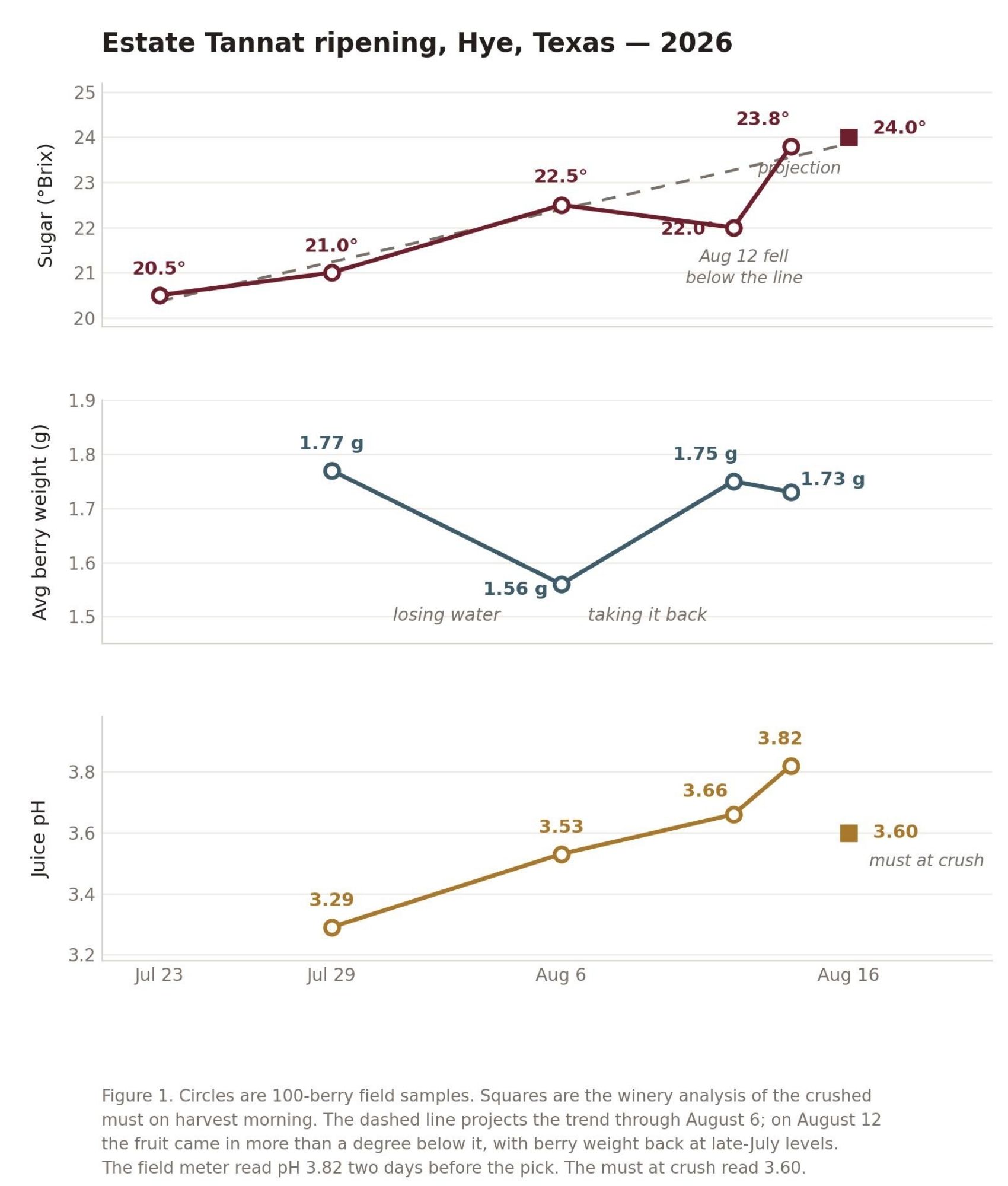
Our estate Tannat read 20.5° Brix on July 23. Six days later it was 21.0°, the berries averaged 1.77 grams apiece, and the juice read pH 3.29. By August 6 the sugar had reached 22.5°, average berry weight had dropped to 1.56 grams, and pH had climbed to 3.53.
The vineyard was clearly telling us something. It was not telling us everything, and six days later it took part of it back.
The instrument everyone knows
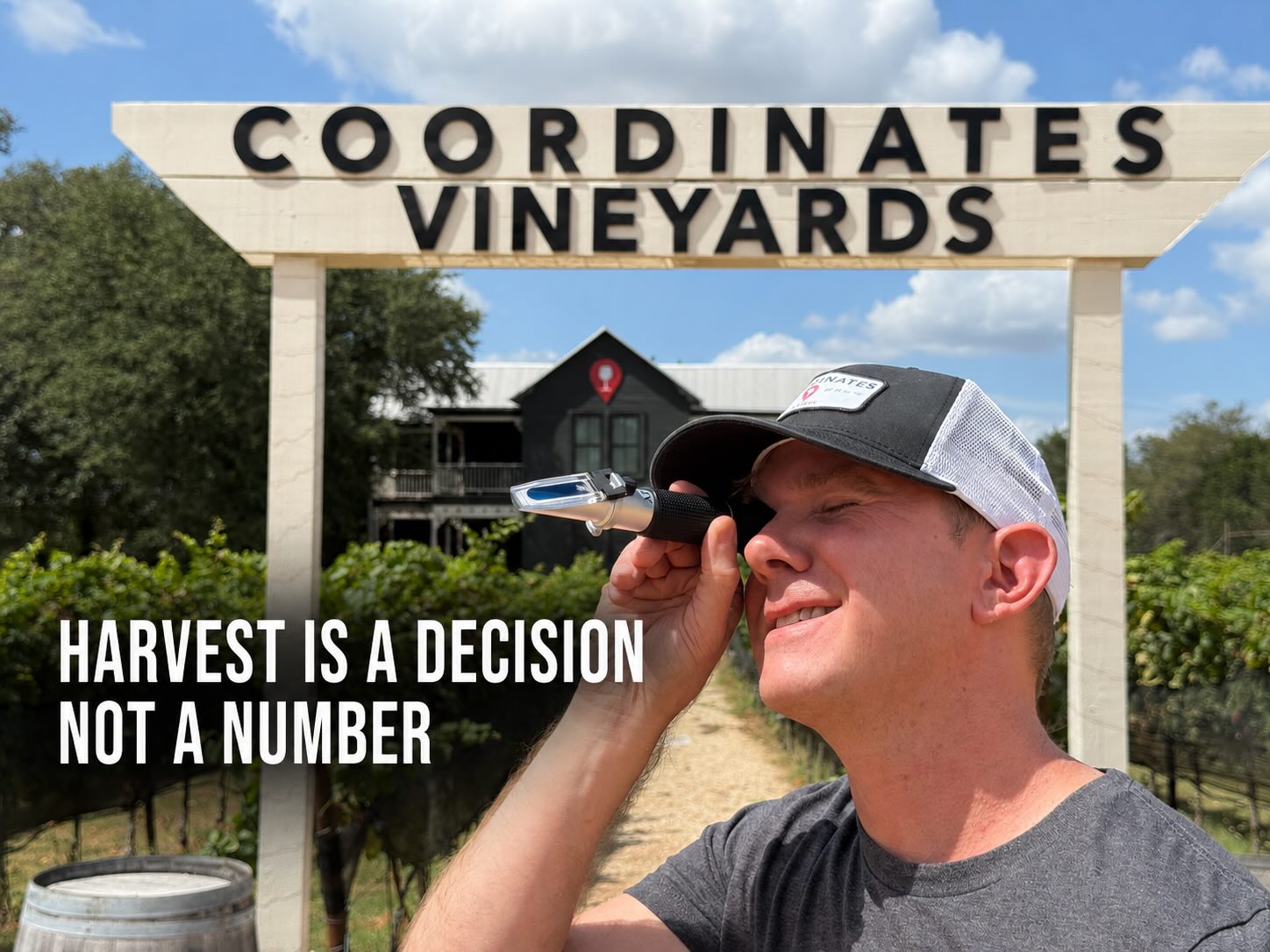
A refractometer looks like a small telescope. You put a drop of juice on the glass prism, close the cover, point it at the sky, and look through the eyepiece at a field split into light and shadow. The line between them lands on a printed scale.
What happens inside is genuinely elegant. Light travels at different speeds through different materials, so when it crosses a boundary it changes direction, and the relationship between the angle going in and the angle coming out is described by Snell’s law:
The more dissolved material the juice carries, sugar above all, the higher its refractive index and the harder the light turns as it enters. It is the same physics that makes a swimming pool look shallower than it is. Light bends as it leaves the water, your eye assumes it traveled straight, and the bottom of the pool appears somewhere it is not.
One degree Brix is defined as one gram of sucrose in one hundred grams of solution. Grape juice is messier than sugar water. Its principal sugars are glucose and fructose, and it also carries acids and minerals, all of which bend light. What the instrument actually reports is total soluble solids, with sugar doing most of the work.
It is a beautiful tool. It answers one question extremely well, and that question is not whether the grapes are ready.
Nothing ripens in a straight line
Between July 23 and July 29 we gained half a degree, about 0.08° per day. Over the next eight days we gained a degree and a half, roughly 0.19° per day. The rate had more than doubled.
Put three points like that on a graph and the temptation is almost physical. Draw the line. Extend it. A straight line through all three readings lands the fruit near 24° Brix around August 16. Now you have a date, and the date feels like knowledge.
On August 12 the estate Tannat read 22.0° Brix.
Not 23.5°, not 24°. Lower than the sample six days earlier. Average berry weight had gone from 1.56 grams back up to 1.75, within a rounding error of where it sat on July 29. And the pH, which does not care what the sugar is doing, had kept climbing to 3.66.
Then, two days later, the fruit came back and made me look foolish for a second time. On August 14 the sugar read 23.8°, berry weight held at 1.73 grams, and the pH had jumped to 3.82.
Look at where that lands on the chart. The projection I had just finished distrusting turned out to be roughly right about the destination. It said the fruit would be near 24° on August 16, and here it was at 23.8° two days early.
I would like to say the line failed. It did not, quite. What it failed at was every single day in between.
On August 12 that line said 23.3°. The fruit said 22.0°. Anyone deciding on the August 12 would have been working from a number that was wrong by more than a degree, and there was no way to know that except by walking out and picking a hundred grapes. A prediction that is accurate about a point two weeks out while being wrong about everything between here and there is not knowledge. It is a coincidence you can only identify afterward, which is exactly when it has stopped being any use.
The mirage
Between July 29 and August 6, average berry weight fell about twelve percent. Those are the same eight days the sugar jumped a degree and a half. Some of that rise was new sugar arriving from the leaves. Some of it was water leaving the fruit. Those are completely different events, one of them is ripening and the other is dehydration, and they produce an identical number on the prism.
Ordinarily you never find out which one you were looking at. This time the water came back.
We irrigated on August 6 and again on August 9, two hours each time, and by the sample on the 12th the berries had filled back out and the sugar had come down with them. The vine had not stopped delivering sugar. We had given the fruit its water back, and more water in the berries lowered the sugar concentration even as the vine kept delivering sugar.
That means the reading responded to something we control. A vineyard can move its own Brix with irrigation. Not by making the fruit riper, but by changing how much water the sugar is dissolved in. If you wanted a flattering number before a pick, you would know exactly what not to do the week before.
So the August 6 reading was true and it was also, in part, an illusion. The fruit was probably not a degree and a half riper than the week before. It was drier.
The August 14 sample is what makes me more confident about that. The sugar jumped almost two degrees and the berries stayed the same size. Same weight, more sugar. That is the shape of actual ripening, and it looks nothing like the week before it.
The number went backward and the fruit got better
At some point we stop measuring and start eating, and this is the part of harvest no laboratory or robot can replace.
Sugar maturity tends to arrive before flavor maturity, and with Tannat the gap can be wide. The variety carries an unusual concentration of phenolic compounds in its skins and seeds, which is why the wine ends up nearly opaque and built like scaffolding. The juice inside almost any wine grape runs clear. The color lives in the skin, which is also why Pinot Grigio grapes are pink and the wine is not. Those same compounds are why fruit can hit its target sugar while the seeds are still green enough to ruin the result.
So we taste the pulp. We chew the skins. We crack the seeds between our teeth, which is unpleasant but informative.
On August 12, that sample told us something the refractometer had flatly contradicted. Most of the seeds had gone dark brown, hard, and crunchy. The skins had softened noticeably from the week before. And the juice was sweeter and more flavorful than the sample that had measured half a degree higher.
Read that again. The number went backward and the fruit got better.
Not everything had arrived as I had hoped. On August 12 there was still a green note on the nose, the vegetal edge that usually means the aromatic side of ripeness has further to go, and I am including that here rather than leaving it out because it was the part of the sample that argued against picking.
The meter that agreed with me, sort of
We watch pH alongside sugar because it answers a different question:
The logarithm is the interesting part. Our pH went from 3.29 to 3.82 in three weeks, which reads like a rounding error and is closer to a 3.4-fold drop in hydrogen ion activity. It matters beyond flavor. As pH climbs, sulfur dioxide protects less and spoilage organisms get more comfortable, so high-pH fruit is simply harder to keep clean.
What matters is whether the meter is telling the truth.
My first pH readings this season drifted from 3.13 to 3.06 to 3.00 and finally 2.92, each appearing on a digital screen with two confident decimal places. Every one was wrong. The calibration solutions had gone off. I replaced them, recalibrated, and threw out the data, which is why the July 23 sample above has a sugar number and no pH beside it.
It happened again on August 12, and the second time was worse, because the wrong answer was believable. Before calibration the meter read 3.54, then drifted to 3.49. Nothing about that looks like a malfunction. It sits perfectly next to the previous week’s 3.53 and tells a comfortable story: the pH has stabilized, the fruit is holding, there is room to wait. I recalibrated anyway, out of habit and mild paranoia, and the same juice came back at 3.66.
That is the difference between an instrument that is broken and one that is merely wrong. The 2.92 announced itself, because a number that slips while you watch it is obviously untrustworthy. The 3.54 announced nothing. It agreed with what I already believed, which is the most dangerous thing a measurement can do.
Everything else knows harvest is coming
Birds do not need a refractometer. Neither do raccoons. They have been watching all along, waiting for their own little harvest.
A ringtail, a small nocturnal relative of the raccoon, has been working our vineyard in Hye and turns up on the motion cameras most weeks, picking his way down the rows with tremendous confidence. We do not know whether he is eating grapes, hunting the animals eating the grapes, or simply inspecting our work. He has, regardless, appointed himself to the harvest committee.
Every wine region has its own committee. In South Africa, baboons come down into the Cape vineyards as the fruit sweetens, largely undeterred by electric fencing and noisemakers, and growers report that the troops have preferences, favoring Pinot Noir and Chardonnay over Bordeaux varieties.
The real question is never whether the grapes could get better. Almost always, they could. The question is whether the improvement from waiting another week is worth the risk of everything that could happen during that week.
What we decided
Four days before the pick, two people I trust looked at the same fruit and told me opposite things.
One said wait. The sugar had gone backward, the fruit needed more time, and another week would likely bring it back. That is a defensible reading.
The other said pick Sunday. The vines were under strain in a stretch of 95-degree days, and every additional week was a week of managing a crop that had more to lose than gain.
Neither was wrong. They were looking through different windows. One was reading a chart. The other was standing in the vineyard. Which is how I learned that the problem with instruments does not stop at instruments. Everyone advising you is also measuring one thing well.
Birds had already found the block, and the netting is not fitted as tightly as it should be. Some berries had started to raisin. The forecast showed the possibility of a storm system arriving before the following weekend, which meant the choice was not Sunday versus next Sunday. It was Sunday versus picking into rain, or picking one day ahead of rain with no room for anything to go wrong. And the container from South Africa was scheduled to arrive sometime Tuesday or Wednesday making the middle of the week impossible.
What remained was not a calculation. It was two lists of contradictions, one for and one against, with no clear number to support either. Waiting might bring half a degree of sugar, possibly a degree, on a curve that had already reversed once. It might soften the green note. Those are real gains and I wanted them. Waiting would also cost more birds, more raisining, a pH already at 3.82 and climbing faster than it had all season, and a possible rain event with no margin behind it. Those risks stack up.
There was one more thing on the scale I had to deliberately take off. Sunday was also the easy day. Thirty-three volunteers had committed to it. The photography was arranged around it. A television station had asked for footage on that timeline. Every one of those things made Sunday convenient, and none of them is a reason to harvest a vineyard.
So I ran it backward. If none of those people existed, no cameras, no crew, no calendar at all, would I still pick on Sunday?
Yes. The birds, the ringtail, the raisining, and the possible storm get us there without any other help.
The morning the vineyard belongs to everyone
For most of the year a vineyard belongs to very few people. Someone prunes it in the cold. Someone tucks shoots in the spring. Someone stands in a row in July arguing with a plastic bag full of crushed grapes.
Harvest morning is different, and it is the best day of the year. The crop takes months to build and then has to come off in hours, so it has always needed many hands at once. We start before sunrise partly for the people, because picking Tannat in Gillespie County at two in the afternoon is a punishment, and mostly for the fruit, which arrives cooler, oxidizes more slowly, and reaches fermentation temperature without a fight.
We hand out buckets and clippers in the dark to friends, family, club members, and volunteers, and people who have never picked a grape end up working a row beside someone who watched the first shoots push in March. It is the day of the year when community forms, and the vineyard belongs to all of us.
What actually happened
We started at 7:15. Thirty-three of the thirty-five people who said they would come showed up, which is a better attendance rate than most weddings. By 8:19 all the fruit was off the vines.
The morning was beautiful. Cool at the start and still, the kind of August day Texas hands out about four times a season. After we finished harvesting the grapes we opened a magnum of our MCC Brut Reserve Blanc de Blancs, and then poured the first bottles of the 2024 Estate Tannat, which is a version of what this morning will turn into. The harvest from today will take 2 years to make into bottled wine.
The block gave us 1,564 pounds. That is less than last year. The birds took some, as did the raccoons and ringtail, and raisined fruit weighs less. Waiting longer would not have added to the total.
Then the must went to the lab, and the last instrument in this story told me something I did not expect.
The pH came back at 3.60.
Not 3.82. The reading that broke the tie, the number I had weighed every other risk against, was more than two tenths higher than the must at crush. This one came from the winery, from the actual must, and a hundred hand-picked berries were never going to be the same thing as an entire block crushed together. The field sample was not lying. It was just a sample, which is what I spent the first section of this article warning you about.
The rest of the harvest numbers were reassuring. Twenty-four degrees Brix. Total acidity 6.9 grams per liter. Acetic acid at 0.04, which is about as clean as fruit gets.
So the number I thought had broken the tie did not describe the block as a whole, and the decision was right anyway.
That is the closest thing to a conclusion I have.
The refractometer is back in its case. The pH probe has been rinsed and stored. The chart has its last point on it.
Every measurement we kept described something real. The refractometer described the juice on its prism. The pH meter described the sample in front of the probe. Even 3.54 described something, though not the grapes. It described how readily I would have believed a number that agreed with me. What none of them described was the vineyard in whole, and not one of them chose the date.
The vineyard never asked us to find the right number. It asked us to recognize the right moment.
Harvest and Ripeness FAQs
What Brix are wine grapes harvested at?
Brix measures total dissolved solids in a liquid, defined as grams of sucrose per hundred grams of solution, and in grape juice sugar accounts for most of those solids. Most reds come off between 22 and 26° Brix and most whites between 19 and 24°, though the range varies by variety, region, and wine style. Sparkling base wine is usually picked considerably lower.
Why can Brix go down during ripening?
Because Brix measures concentration, not quantity. Rain or irrigation can rehydrate berries and dilute the soluble solids, which lowers the reading even though nothing has been lost. Tracking average berry weight alongside Brix helps distinguish real sugar accumulation from water moving in and out of the fruit.
Does higher Brix make better wine?
No. Higher Brix creates the potential for higher alcohol, which is a different thing from quality. As ripening continues, higher Brix often coincides with falling acidity and a rising pH that complicates cellar work. The right target depends entirely on the wine you intend to make.
What is hang time?
The stretch when fruit stays on the vine after reaching adequate sugar, in hopes that tannins, aromas, and color keep developing. It can improve a wine considerably. It also exposes the crop to more weather, more rot pressure, and more wildlife.
When is harvest in the Texas Hill Country?
Earlier than most people expect. Picking generally begins in late July or August and can run into September, depending on variety, vineyard, weather, and the style of wine being made.
What is Tannat?
A thick-skinned red variety originally from southwest France, now most famous as the signature grape of Uruguay, known for exceptionally high tannin and phenolic content. It produces deeply colored, structured wines built to age, including our 2024 Estate Tannat.