Alone in the Vineyard
I was alone in the vineyard before the day really started.
That is one of the strange gifts of farming. Most of the important moments happen quietly. No music. No crowd. No glass raised in celebration. Just dirt, wind, vines, and the long list of things you still do not know.
Our Tannat vines sit in front of the tasting room at our Coordinates Vineyard Farmhouse in Hye, Texas, right along the Highway 290 wine trail. Most people drive by on their way to a wine tasting without realizing how much life is happening in those rows.
In winter, the vineyard does not look like much. The vines are bare. The leaves are gone. The whole thing can look almost dead if you do not know what you are looking at.
But dormancy is not death.
It is rest. It is preparation. It is the vine pulling its energy back into the roots, waiting for the right moment to begin again.
I have thought about that a lot.
When we opened Coordinates Vineyards in Fredericksburg, the story was already bigger than one tasting room. It had South Africa in it. It had travel in it. It had my brother Mahlon. It had years of getting lost, trying to find something, and eventually realizing the wrong turns were part of the map.
But the Hye vineyard changed something for me.
It put roots in the ground.
It rooted me.
The Call to Care for What Was Right in Front of Us
Tannat is not an easy grape. That is part of why I respect it. It has structure, color, tannin, and intensity. It can be bold and stubborn. It needs time. It does not apologize for itself.
In that way, it reminds me a bit of Texas itself.
For a long time, Coordinates was about reaching outward. South Africa. California. High Plains Texas vineyards. Different places, different people, different wines connected by a shared story. The name itself came from getting lost in the South African winelands and learning to trust the coordinates.
But this estate Tannat asked a different question.
Could we take care of what was right in front of us?
Not just pour great wines from meaningful places. Not just tell stories from vineyards across the world. Could we farm our own vines in Hye, carry them through a Texas growing season, make the decisions, accept the failures, and bottle something that belonged to this place?
It started with a quiet vineyard and a question I was not sure we were ready to answer.
Winter: Choosing What the Vine Can Carry
The journey starts long before anyone drinks the wine.
In winter, we prune.
That sounds simple, but pruning is one of the most important decisions of the year. You are shaping the future before it exists. You cut away what the vine no longer needs and decide what it will carry into the next season.
Too much fruit, and the vine cannot ripen it well. Too little, and you waste what the vineyard was capable of giving.
It feels like farming, but it also feels like life.
You cannot carry everything forward.
At that stage, the vineyard still felt lonely. A lot of Coordinates still did too. There were moments when it felt like the work had outgrown the number of hands available to do it. At one point, it was just Adam and me, trying to keep the whole thing moving.
Two people. Two tasting rooms. Too many rows of vines. Too many problems. Too much still to learn.
But that is how a lot of things begin. Quietly. Imperfectly. With more responsibility than certainty. And a dogged determination to see things through.
Spring: Budbreak and Risk
When spring comes, the vineyard wakes up.
Budbreak is the first visible sign that the season has begun. Tiny green leaves push out from wood that looked lifeless only weeks before. Shoots stretch. The rows begin to soften. The vineyard starts to look alive again.
That first green is beautiful, but it is also vulnerable.
Once the vine wakes up, the risks wake up too.
Cold snaps. Wind. Hail. Disease pressure. Insects. Too much rain. Not enough rain. Every week brings a new problem to solve.
Wine is romantic in the glass. In the vineyard, it is mostly work and worry.
Hail on the Roof
I remember standing on the porch that spring while hail pounded down on the roof.
The sound was violent. Hard, sharp, relentless. And all I could think about was the vineyard outside taking whatever came.
We did not have the nets up yet. There was nothing I could do in that moment.
That is one of the hardest feelings in farming. You can care deeply, work constantly, and still find yourself completely unable to help.
The vines do not care how badly you want the storm to pass. They do not care how tired you are.
Late Spring: Growth, Canopy, and the Work No One Sees
After budbreak, the vineyard starts moving fast. Really fast.
Shoots grow. Leaves expand. The canopy begins to form. The vines are no longer sleeping. They are reaching.
This is when the work becomes more detailed.
I’ve spent countless hours shoot tucking and leaf pulling, moving slowly down the rows, vine after vine. You tuck shoots into the wires. You pull leaves around the fruit zone. You try to open the clusters up for airflow without stripping away too much protection.
That work becomes almost meditative after a while.
Shoot tuck. Step forward. Leaf pull. Step forward. Look closer. Adjust. Keep moving.
Your hands start to understand the vineyard before your mind does.
Designing Shade for the Western Sun
In the Texas Hill Country, sunlight is not the problem. We have plenty of it.
The challenge is learning how to use it without letting it punish the grapes.
We worked on lateral pruning and canopy design to help shade the fruit from the hot afternoon western sun. Too much shade, and the grapes struggle to ripen. Too much exposure, and the clusters can bake.
That balance is part of the wine before it ever becomes wine.
It is in the way the leaves are positioned. The way the shoots are tucked. The way the fruit hangs. The way the vineyard is asked to protect itself. It’s the work you can’t see but taste in the glass. Important, yet often times feels thankless, tough and exhausting.
Fruit Set: The Vintage Begins to Take Shape
Before there is fruit, there are flowers.
Flowering is easy to miss if you are not paying attention, but it is one of the most important moments of the year. Those small flowers become the clusters that eventually become the wine.
Fruit set tells you what kind of crop you may be working with.
Not what you will have. Not yet. Farming does not give certainty that early.
But you begin to see the shape of the season. You begin to count what might make it. You begin to imagine the wine, even though you know better than to trust that image too much.
There is still too much road ahead.
Early Summer: Weeds, Leaves, Leaks, and Questions
By early summer, the vineyard is no longer quiet.
Everything is growing. The vines. The weeds. The problems.
Weed control became constant. Walk the rows. Clear what is competing with the vines. Come back and do it again.
Then there were the leaves.
A strange color. An unusual pattern. Something that looked a little off. I would find myself staring at a leaf and then searching through textbooks, trying to match what I was seeing to a possible nutrient deficiency.
Was it magnesium? Potassium? Something else? Was it a real problem, or was I just tired and looking too hard?
That is part of the work too.
The details matter.
The Irrigation Line Between Stress and Survival
Then came the heat.
There is a strange balance in farming grapes. You do not want the vines too comfortable. A little water stress can help the vine focus its energy and build concentration in the fruit.
But water-stressed is not the same as water-starved.
That line matters.
Some days were spent chasing leaks, fixing irrigation, and trying to decide whether we were helping the vines or barely keeping up. In a glass of wine, people talk about concentration and structure. In the vineyard, sometimes that starts with a cracked irrigation line, an unusually hot day, and someone sweating through their shirt trying to keep the vines alive.
Storm Windows and Early Alarms
Some mornings started before sunrise because that was the only chance we had.
If a storm was coming, we had to decide whether the wind might stay low enough to get a protective spray on before it arrived. That meant early alarms, checking the weather, watching the trees, looking for any small window when the vineyard risk could be hedged against.
There is nothing glamorous about that part.
You are tired. The day has not even started. Most people are still asleep. But the vineyard is already asking for something.
And the grapes do not care how much you don’t want to do it.
That became one of the lessons of this wine.
There is no shortcut around the work. There is only the effort you put into it.
And the effort was tremendous.
Blood, sweat, tears, all of it.
It may be a small vineyard compared to those in California and South Africa, but I’d be lying if I didn’t say there were times when it all felt like too much.
Veraison: When Everything Starts Watching
Then veraison begins.
The grapes start to change color. Each green berry shifts individually toward a deep purple hue. The vineyard transforms slowly, unevenly, almost shyly.
The spotted clusters are incredible. It is one of the most beautiful stages of the season.
It is also when everything else starts paying attention.
The birds notice.
The raccoons notice.
The fruit that you have been nurturing for months suddenly becomes the thing everyone wants.
The Fight to Keep the Fruit
We put up nets. And still, the raccoons and birds fought their way through.
There were mornings when I would walk the rows and find places where the nets had been pulled apart or pushed through. You could see exactly where something had tried to get in.
So I fixed them.
Again and again.
Sometimes that meant sticking the nets back together with zip ties, doing whatever we had to do to protect the fruit for one more day.
That may not sound like winemaking, but it is.
Every cluster that made it to harvest had to survive the heat, the storms, the insects, the birds, the raccoons, the weeds, the irrigation problems, the timing, and our own mistakes.
By then, the vineyard did not feel like something we owned.
It felt like something we had been trusted to carry.
Ripening: The Long Wait Before the Decision
As the fruit ripened, the work changed again.
You start tasting the grapes differently. Not looking. Tasting.
You walk the rows and pull berries from different spots. You chew the skins. You feel the seeds. You look for flavor, not just sugar. Lab numbers matter, but numbers do not tell the whole truth.
A grape can look ready on paper and still not be ready in your mouth.
That is something I have learned from winemakers I respect. Great wine is not made by chasing a spreadsheet. It is made by listening to the vineyard, then having the patience to act at the right time.
But patience gets harder when the fruit is ready and everything else still wants it.
The birds are still watching. The raccoons are still trying. The weather is still changing. You are trying to wait long enough for the wine to be right, but not so long that the season takes it away from you.
Harvest is not just a date.
It is a decision. And like many in life, always an imperfect one.
The Night Before Harvest
The nets had to come down the day before harvest so we could be ready in the early morning.
That made me nervous.
For months, I had been trying to protect the fruit. Then, at the exact moment it was ripe, I had to uncover it.
The birds and raccoons had been trying to reach those grapes since veraison. Now the fruit was exposed, and all we could do was hope it would still be there in the morning.
You spend a season trying to control what you can.
Then the night before harvest reminds you how little control you really have.
That night felt long. Really long. I don’t think I slept at all.
Harvest Morning: From Alone to Supported
Harvest day started early.
At 5:00 a.m. I stopped pretending and got up to work. Volunteers arrived at 6:30 a.m.
It was the kind of morning where the air still feels forgiving before the heat arrives.
And this is where the story changed.
This wine did not end the way it began.
It began with me alone in the vineyard, looking at dormant vines and wondering what we were really capable of carrying.
But harvest morning had more hands.
First it was two of us. Then three. Then five. Then six. Then wine club members and friends who showed up before most of the world had started its day.
That growth mattered.
Not just because we needed help, although we did. It mattered because it showed what Coordinates was becoming.
A winery can start with an idea. It can start with a story. It can start with two brothers, a tasting room, and a name pulled from getting lost on the other side of the world.
But at some point, if you are lucky, it becomes more than that.
It becomes people.
It becomes a club. A team. A family. A group of hands willing to show up when the work is real.
To our wine club members who came out to help harvest, thank you.
You did not just come to drink wine after it was finished. You became part of the story before it existed in the bottle.
That matters more than I can probably say well.
There is a different feeling when people who have supported Coordinates are standing in the vineyard with clippers in their hands, helping bring in fruit from the vines in front of the farmhouse. It turns the wine from a product into a memory.
That morning was not just about picking grapes.
It was about community.
It was about the strange, beautiful thing that happens when a winery stops being only a business and starts becoming a shared place.
From Single Grape to Wine
After harvest, the grapes began the next part of their journey.
They were sorted. Crushed. Moved into fermentation. The fruit that had survived the season began to become something else.
People imagine winemaking as standing around barrels with a thief in hand, saying poetic things about blackberry and leather.
There is some of that.
There is also a lot of hoses, pumps, wet boots, sticky floors, and wondering why something that should take twenty minutes has now taken three hours.
Fermentation is where the grape becomes wine, but it is not magic in the easy sense. It is living biology, and living things do not always follow instructions.
Sugar turns to alcohol. Skins give color and structure. Seeds and tannins start to shape the wine. The fruit begins to show what it wants to be.
For Tannat, that structure matters.
This is a grape with backbone. It has intensity. It has tannin. It needs time, patience, and careful handling. If you rush it, the wine tells on you.
Pressing, Aging, and Waiting
After fermentation, the wine is pressed.
The skins and seeds that gave the wine its color and structure are separated from the young wine. It is one of those steps that feels both physical and symbolic.
The fruit has given what it can. Now, it’s all about time.
The wine has to begin becoming itself, and there’s no way to rush the process.
For a red wine like Tannat, time is not optional. It needs room to settle into itself. Those tannins that make it powerful also need patience.
Oak can help shape the wine, but it should not bury it. The goal is not to make a wine that tastes like a barrel. The goal is to make a wine that tastes like the vineyard, with enough polish to carry the story clearly.
Waiting is harder than people think.
You taste. You wonder. You second-guess. You try to decide whether the wine needs more time, more air, more structure, more softness, or just enough patience to stop interfering.
Blending: Listening to the Wine
At some point, blending becomes the next conversation.
Blending is not about hiding flaws. At least it should not be. It is about finding balance.
Sometimes one barrel has the structure. Another has the fruit. Another brings lift or softness or a line of acidity that makes everything feel more alive.
You taste, adjust, taste again, and try not to talk yourself into something just because you want it to work.
This is one of the hardest parts of wine.
You have to be honest.
You can love a wine and still know it needs something. You can love an idea and still admit the glass is telling you the truth.
That is where this wine kept teaching us.
It had survived the season. It had made it through fermentation. It had aged. It had waited. Now it needs guidance to become complete.
The New Reality: Coordinates Had Grown Too
By the time this wine was ready to bottle, Coordinates had changed too.
The vineyard had gone from bare wood to green shoots, from flowers to fruit, from single grapes to wine.
And we had gone from feeling like two people trying to hold everything together to something larger.
Three people. Five people. Six people. A growing team. A growing wine club. A growing group of guests and members who cared enough to follow the story, show up for the work, and become part of the place.
That is the part I do not want to lose.
Coordinates is still growing. We are still learning. We still make mistakes. There are still days when the work feels bigger than we are.
But this wine marked a shift.
It was no longer just about where we had been.
It was about what we were becoming.
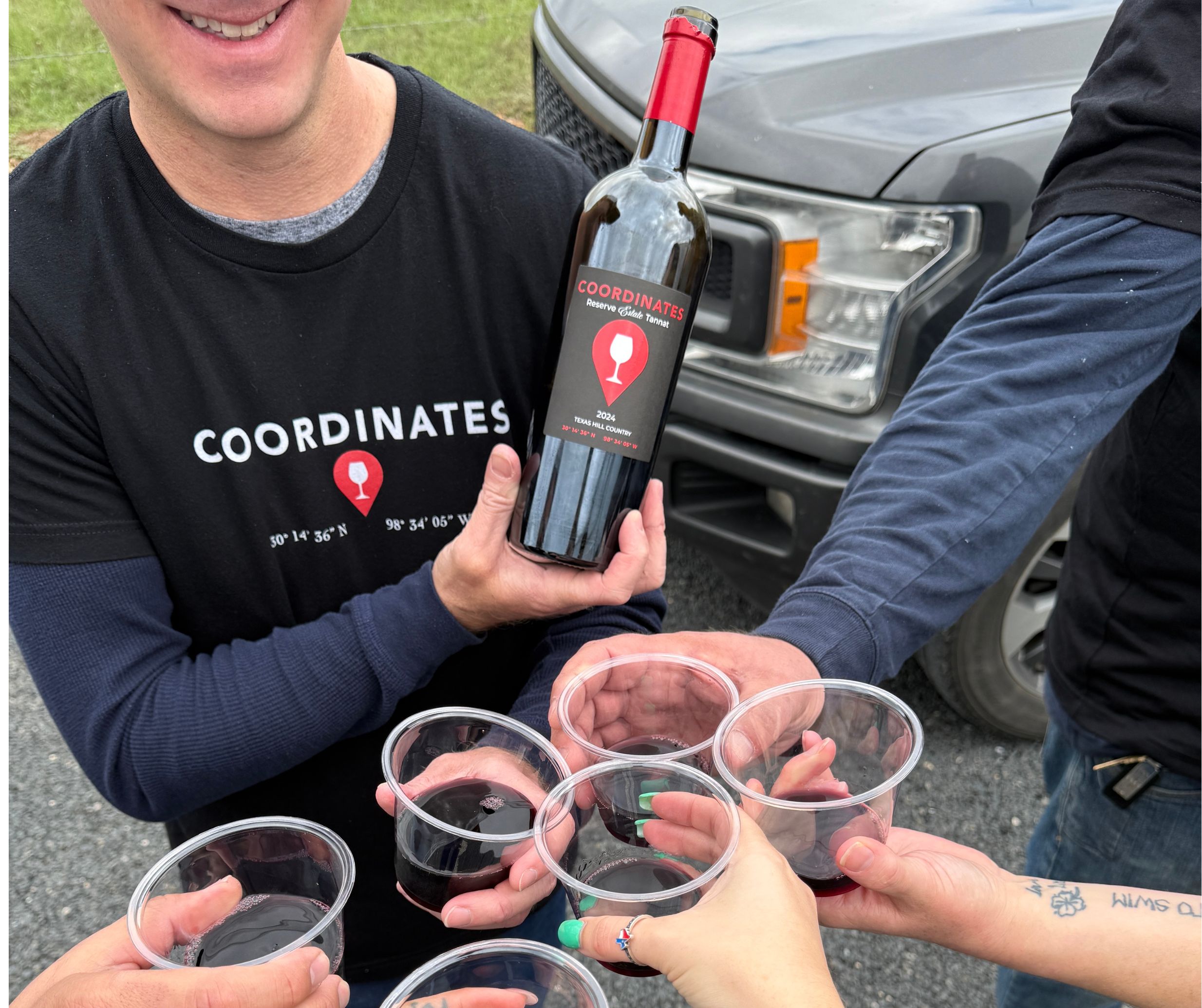
This Estate Tannat is not only a Texas Hill Country wine. It is not only an estate-grown Tannat from Hye. It is a marker of where Coordinates Vineyards has been, where we are now, and where we are trying to go.
Bottling Day: The Climax of the Journey
Last Thursday, that journey reached the bottling line.
Bottling day is funny because it feels like the end, but it is really another beginning.
The wine had already been through so much by then.
Dormancy. Pruning. Budbreak. Shoot growth. Canopy work. Flowering. Fruit set. Hail. Heat. Weeds. Nutrient questions. Early morning sprays. Cracked irrigation lines. Veraison. Birds. Raccoons. Nets. Zip ties. Harvest. Fermentation. Pressing. Aging. Blending. Filtering. Planning. Worrying.
Then suddenly the team was together, and the wine was moving.
Empty bottles became full bottles. Corks went in. Capsules were placed. Labels were applied. Cases stacked up one by one.
The thing that had lived in the field, then in bins, then in barrels, finally became something someone could hold.
That part got me.
Not because it was perfect. Bottling days never are. There is always some small problem, some adjustment, some moment where everyone has to stop and figure it out.
But that is also the point.
Wine is not made by one person standing alone in a vineyard, even if that is where this story began.
It takes a team.
It takes the people who farm, the people who harvest, the people who make the wine, the people who bottle, the people who pour it, and the people who eventually sit across from us in Fredericksburg or Hye and give the wine a place to land.
What Terroir Really Means
People talk about terroir as a sense of place.
That is true, but it is not enough.
Terroir is the land, the air, the sun, the wind, and the people who bring the wine its soul.
It is the soil and the heat. It is the storm you could not stop. It is the cracked irrigation line you had to fix. It is the zip tie holding a net together for one more night. It is the wine club member who showed up before sunrise. It is the team that kept going when everyone was tired.
Even when our wines come from far-off places, they are never just grown in some disconnected vineyard.
They are grown out of love. Out of struggle. Out of persistence. Out of the stubborn belief that something meaningful can come from staying with the work long enough to see it through.
It is grown with Coordinates.
Only About 500 Bottles
Our Estate Tannat came in as something small, but meaningful.
We are not talking about thousands and thousands of cases. We bottled about 500 bottles.
That number matters.
It means this wine will never be everywhere. It means every bottle carries a real piece of this place, from the front vineyard at our Hye farmhouse to the people who helped bring it across the finish line.
It also means this wine is limited in a way that feels honest.
Not limited because someone decided to make it sound exclusive. Limited because that is what the vineyard gave us. Limited because the birds got some, the raccoons tried for more, the heat took its share, and what remained had to be earned.
That is why this one is special.
What I Hope You Taste
That is what I hope people taste in this Estate Tannat.
Not just dark fruit. Not just structure. Not just the bold character that makes Tannat such a compelling Texas wine.
I hope they taste the year.
The cold quiet of dormancy. The first green push of spring. The hail on the roof. The hot western sun. The early mornings. The nets. The birds. The raccoons. The zip ties. The cracked irrigation lines. The hands in the canopy. The harvest bins. The wine club members. The team. The exhaustion. The effort. There’s another post about how Harvest is a Decision not a Number if you care to learn more about how we decide when to pick the vineyard.
And maybe, if we did our job right, they will taste a little bit of Coordinates growing up too.
This wine came from our vineyard in Hye, but it belongs to the whole journey. From a quiet morning in the field to a team working together, it reminds me why we started this in the first place.
Every bottle tells a story.
This one just happens to start at home.
Visit Coordinates Vineyards in Hye or Fredericksburg
Our Estate Tannat will be extremely limited, with only about 500 bottles produced. Join our Coordinates Vineyards Wine Club or visit us in Hye or Fredericksburg and follow our socials for release information and taste the next chapter of Coordinates Vineyards.
Reserve your wine tasting experience and explore award-winning wines from Texas, South Africa, and California at Coordinates Vineyards.