The most memorable tasting note I have ever heard wasn’t blackberry, leather or tobacco. It was story time and boyfriends.
By Austin Kerr, co-owner, Coordinates Vineyards
Every wine Jill tasted got a three.
We were at my friend Tim’s apartment in Taiwan, working through South African wine samples for the winery my brother Mahlon and I were preparing to open in Texas. I had asked everyone to score each wine from one to five.
Jill was the teacher who had arrived to replace me.
Three was a sensible answer. She was new to the group, wine wasn’t really her world, and she had walked into a room full of people who had known one another for years and were preparing to say goodbye to someone she barely knew.
Three said she was participating.
It also made it reasonably unlikely that I would ask a follow-up question.
Unfortunately for Jill, I was still a teacher even with wine in my hand.
A tasting in Taiwan
I had lived in Taiwan for eleven years. Long enough that leaving no longer felt like moving somewhere new. It felt like taking apart a life.
I had watched plenty of other people do it. You promise to stay in touch, and you mean it. Then time zones do their work. Eventually you discover how much of friendship is held together simply by being close enough to show up.
I had never expected to be the one leaving.
Taiwan had become home. I had students, colleagues, friends and even a favorite 7-Eleven, which makes more sense if you have lived there long enough to know that a Taiwanese 7-Eleven is practically infrastructure.
Now I was packing eleven years into boxes.
The tastings during those final months served two purposes. I genuinely needed opinions on the wines we were considering, but I also think I was practicing the future before I had reached it.
Tim hosted this one. I brought the wine.
Ten or twelve of us sat, stood and leaned wherever his apartment had room. We tasted the samples early because people become remarkably generous wine critics after several glasses.
I kept notes.
What did they like? Would they buy it? How much would they pay?
My best friend Thomas contributed particularly useful data.
“What do you smell?”
“Grapes.”
“What do you taste?”
“Grapes.”
He had developed a system.
There was sadness underneath the joke. I was leaving the school he had brought me to and a life we had shared for years.
The least he could do was ruin my market research.
Jill took a different approach.
Three.
Another wine. Three.
Then another.
Three.
Then I poured the Pinotage.
Jill smelled her glass and looked up before I had even finished pouring around the room.
“Five.”
I stopped.
“This is a five?”
“Five.”
“Okay. Why?”
Her boyfriend was sitting beside her and looked perfectly comfortable until she answered.
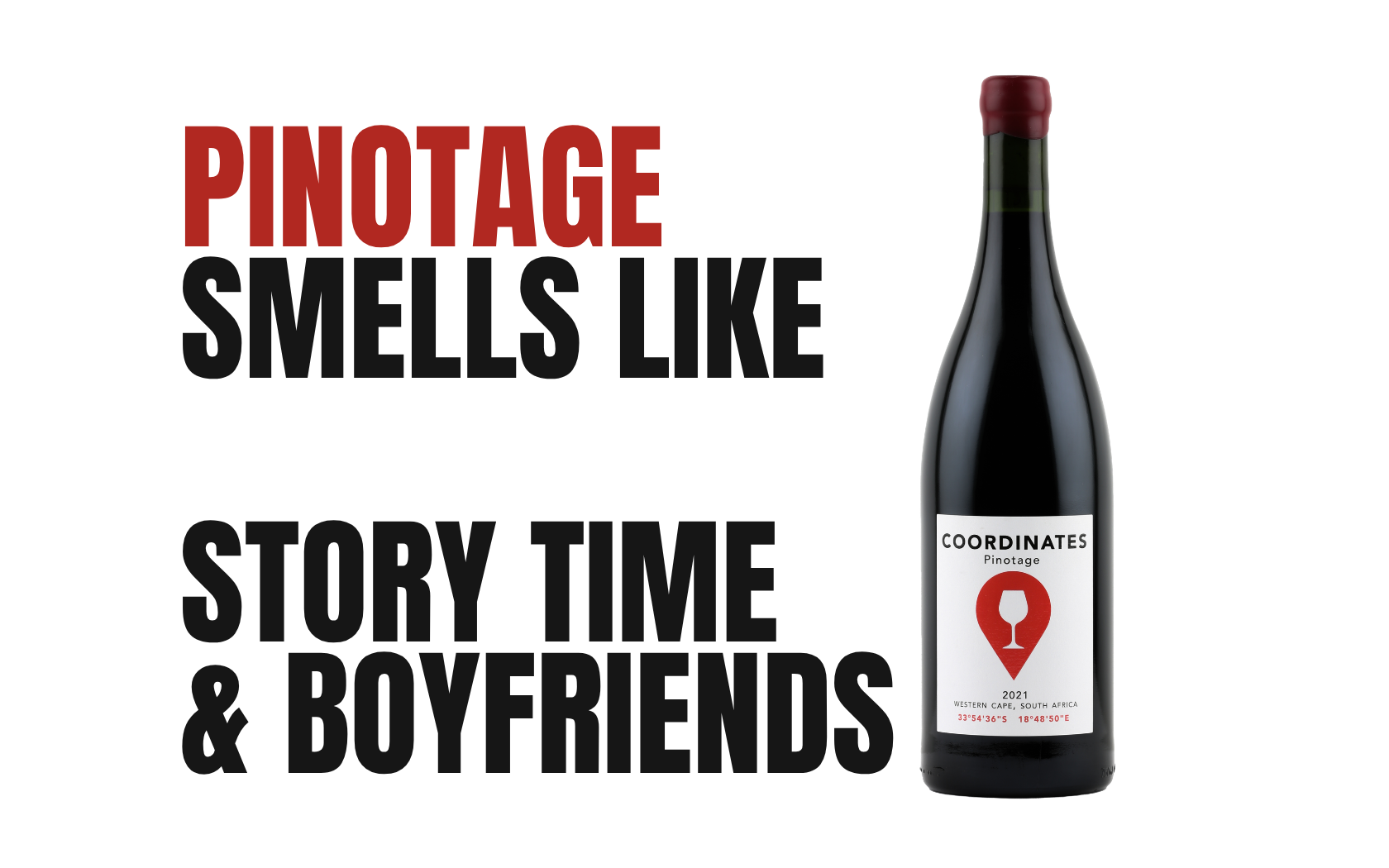
“This smells like story time and boyfriends.”
His head turned.
The room laughed.
But Jill kept talking.
She said the wine reminded her of the rug they sat on during story time in fifth grade. Maybe it was the rug. Maybe the classroom. Maybe something about that particular period of her life.
She couldn’t explain the connection exactly.
For the first several wines, I had been trying to persuade her to tell me what she thought. Now she was explaining a childhood classroom rug to an apartment full of people, and her boyfriend was probably wishing she had stayed with three.
I had stopped caring about the score.
The answer sheet myth
Years later, people still ask some version of the same question at the tasting bar.
“What am I supposed to smell?”
Sometimes they ask quietly.
They smell their glass, hear someone beside them say blackberry or cedar or tobacco, smell it again and look slightly concerned.
They think everyone else received the answer sheet.
Wine has done a remarkable job of convincing people that tasting it correctly requires a vocabulary they were somehow supposed to learn before walking through the door.
There is useful language in wine, of course. We need ways to talk about acidity, tannin, fruit, oak, fermentation and structure. If I am discussing a wine with a winemaker thousands of miles away, precision matters.
But that is different from believing the technical description is the only legitimate experience of a wine.
If I smell blackberry and you smell something from your grandfather’s garage, I am not necessarily right and you are not necessarily wrong.
You brought your nose to the glass.
And you brought everything that has ever happened to that nose with it.
Smell is memory
There is some biology behind this.
Smell is unusual among our senses because its pathways have direct connections with parts of the brain involved in emotion and memory. That is one reason an aroma can bring back a place, a person or a moment before you have consciously gone looking for it.
Which is more or less what happened to Jill.
That is why tasting notes are useful, but limited.
If I tell you a wine smells like blackberry, that may help you recognize something already in the glass. It should not convince you that you failed if you don’t smell blackberry.
And it certainly should not stop you from saying that the wine reminds you of a classroom, a garage, your grandmother’s kitchen or somewhere you haven’t thought about in twenty years.
Those are the tasting notes I tend to remember.
Before the wine, she was new
The part of the story I think about now isn’t really the tasting note.
It is what happened to the room.
Before the Pinotage, Jill was the new person. She had replaced me at school. Everyone else already shared histories and jokes she wasn’t part of.
She was being careful.
Three. Three. Three.
Then something came out of that glass that belonged completely to her, and she told us about it.
Suddenly we weren’t talking about whether she liked the wine enough to give it a four or a five. We were talking about her. The classroom. The rug. The boyfriend sitting beside her wondering exactly how many boyfriends were involved in this memory.
She had given everybody something to laugh about together.
Before that wine, she had been new.
Afterward, she was part of the room.
What I wanted Coordinates to feel like
At the time, I thought I was conducting research.
Which wines should we buy? Which wines would sell? What would Americans think of the South African bottles Mahlon and I wanted to build part of the winery around?
That evening taught me something more useful.
I didn’t want tasting wine to feel like taking a test.
I wanted people to ask questions. I wanted someone who knew nothing about wine to be able to sit beside someone who knew quite a lot about it and have both of them contribute something to the conversation.
You should be allowed to dislike something.
You should be allowed to love something you weren’t expecting to love.
And you should be allowed to describe a wine using words that would never appear in a sommelier textbook.
That is still one of my favorite moments behind the bar.
Someone takes a sip, smells the glass again and says:
“You know what this reminds me of?”
Yes.
Tell me.
The wine happened to be Pinotage
The wine that broke Jill’s streak of threes was Pinotage.
Today, Pinotage is our best-selling wine at Coordinates.
We didn’t plan that. Guests decided it.
A lot of people walk through our doors having never heard of the grape. Some have tasted one before and already decided they don’t like it.
Then we pour ours.
Sometimes they buy a bottle. Sometimes several. Sometimes they simply discover that Pinotage is more complicated than whatever they thought it was.
And every once in a while, somebody gives us a tasting note we remember years later.
I would rather have that than get everyone in the room to agree on blackberry.
Five Pinotages, one night
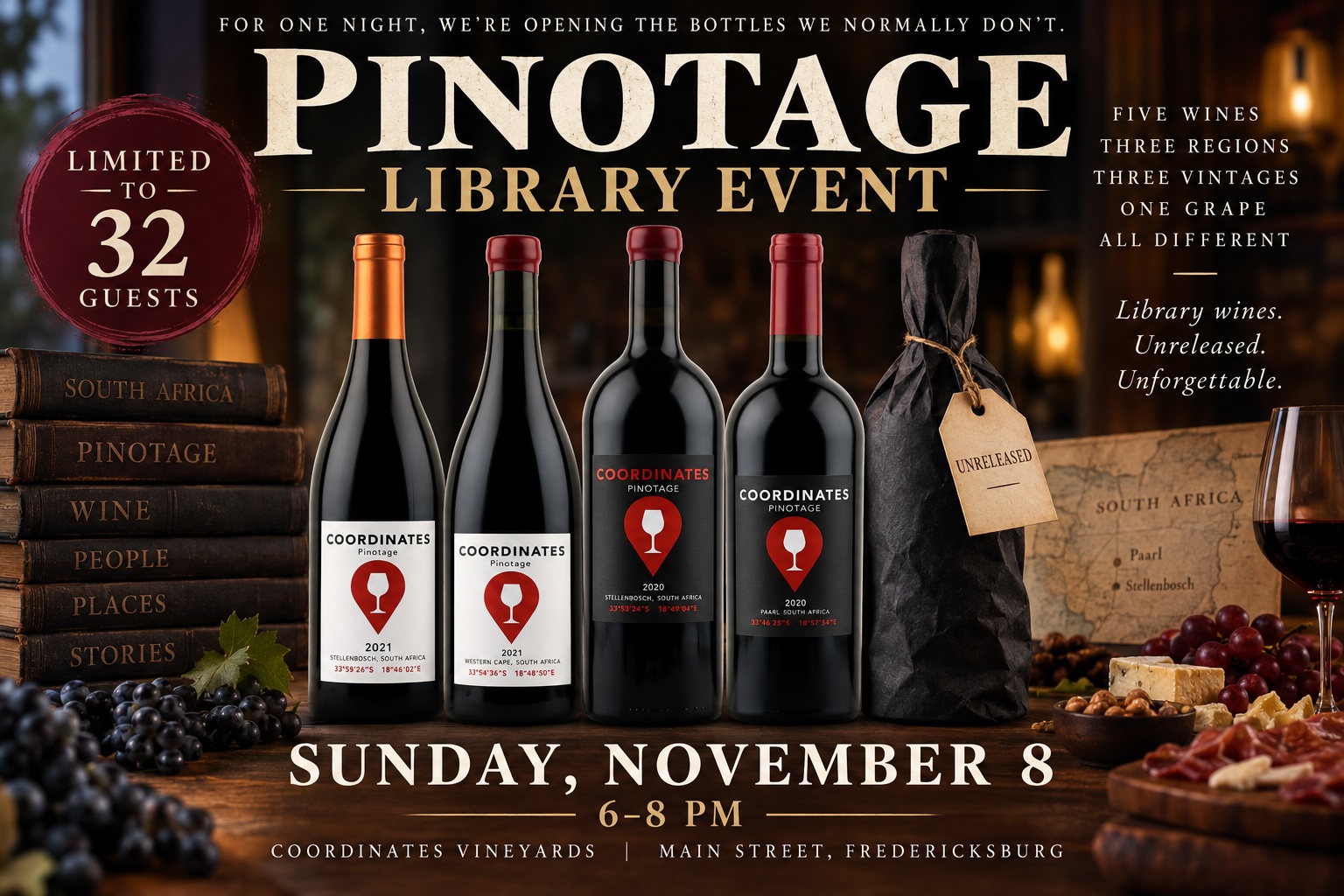
On Sunday, November 8, from 6–8 p.m., we’re opening five South African Pinotages for just 32 guests at our Main Street tasting room in Fredericksburg.
We’ll pour wines from different producers, regions and vintages, including Rolanie’s unreleased 2022 Rhebokskloof Reserve Pinotage.
That 2022 will be poured and available to purchase that night only. Our library bottles will also be available for purchase during the event.
Wine club members received first access.
The point of putting five Pinotages side by side isn’t to arrive at five correct tasting notes.
It is to see what changes from one glass to the next, what each person notices, and where the wines take the room.
Five wines do not create five experiences.
Put a room full of people around them and everyone brings something different to the glass.
Pinotage Library Tasting
Sunday, November 8, 2026
6–8 p.m.
Coordinates Vineyards, Main Street, Fredericksburg
32 seats
Tickets:
https://coordinatesvineyards.orderport.net/product-details/0210/pinotage-library-tasting-event
What does Pinotage smell like?
I can give you our tasting notes.
I can tell you what the winemaker found.
I can tell you what I smell.
Those are useful places to begin.
They aren’t the final answer.
Jill’s Pinotage smelled like story time and boyfriends.
That belonged to her.
Yours probably won’t.
The better question is what it smells like to you.