The short version · By Austin Kerr · Updated
- Chardonnay is a natural cross of Pinot and Gouais Blanc, a peasant grape French authorities tried more than once to outlaw. DNA research at UC Davis confirmed the parentage in 1999.
- It is called “the winemaker’s grape” because it has few strong aromas of its own, so climate and cellar choices like malolactic fermentation and oak shape how it tastes.
- The buttery flavor comes from diacetyl, made during malolactic fermentation. Coconut and vanilla come from oak barrels.
- Chablis grows on Kimmeridgian limestone about 150 million years old and full of fossil oysters. In Robertson, South Africa, calcium carbonate can build up in soils linked to termite mounds called heuweltjies.
- At the 1976 Judgment of Paris, French judges ranked the 1973 Chateau Montelena Chardonnay from Napa above top white Burgundies, and that wine had no butter.
In 1999, a plant geneticist at UC Davis named Carole Meredith helped answer a question wine lovers had been asking for centuries: where did Chardonnay come from?
For centuries, people had told romantic stories about where Chardonnay came from. Some said Crusaders carried it home from the Middle East. Others thought the Romans planted it. Meredith and her doctoral student John Bowers ran DNA from three hundred grape varieties and found something much stranger. Chardonnay was the child of two grapes growing side by side in medieval northeastern France. One was Pinot, the noble grape of Burgundy’s monasteries and aristocrats. The other was Gouais Blanc.
You have probably never heard of Gouais Blanc. For centuries, it had very little prestige. It was the peasant grape of the Middle Ages, a heavy-cropping vine that made thin, acidic wine and got planted on whatever ground the good grapes didn’t need. Its name likely comes from an old French word of contempt. Between the late 1500s and the 1700s, authorities tried more than once to outlaw it. In 1732, the Parlement of Besançon went after it in writing, describing it as rustic, inferior, and high-yielding, which was meant as an insult.
Meredith’s team put the odds of being wrong at less than one in a trillion. And the peasant grape turned out to be the mother. A later study from the University of Cambridge traced the chloroplast DNA, which grapevines pass down only through the maternal line, and found Gouais Blanc on Chardonnay’s side of the family tree.
That same pairing produced more than a dozen siblings, including Gamay, Aligoté, and Melon de Bourgogne, the grape behind Muscadet. One unremarkable vine, crossed with Pinot over and over in the same fields, gave Europe a good share of its classic white and red grapes.
The name came later, from a place. There is a village called Chardonnay in the Mâconnais, in southern Burgundy, with about two hundred residents. The name traces back to the Latin Cardonnacum. Some say it meant the land of a Roman-era owner named Cardus. Others say it meant a place of thistles. Producers there tell the thistles story, and they will add that thistles love limestone, and that their village sits on it.
Keep that limestone in mind. It comes back.
The winemaker’s grape
People in the wine trade call Chardonnay “the winemaker’s grape,” and it is meant as a compliment and a warning at the same time.
Here is the science behind the phrase. Some grapes arrive at the winery already loud. Sauvignon Blanc carries aroma compounds called thiols and pyrazines, which can give it aromas of grapefruit and cut grass. Riesling and Muscat are packed with floral compounds called terpenes. Chardonnay has relatively little of its own to say. It is a quiet grape with a lot of structure: good acid, a willingness to ripen in many climates, and a texture that holds up to almost anything a winemaker does to it.
So the flavor of a Chardonnay is mostly a record of decisions. Four of them do most of the work.
Where it grew. In a cool place, grapes hold on to malic acid, the sharp acid in green apples, and the wine tastes of lemon, apple, and wet stone. In a warm place, the vine burns through that malic acid as the grapes ripen, and the flavors move toward peach, pineapple, and mango. Same vine, different sun.
Whether the winemaker lets the butter in. After the yeast finishes, many winemakers allow a second fermentation, carried out by bacteria, that turns malic acid into the softer lactic acid found in milk. It’s called malolactic fermentation, and one of its byproducts is a molecule called diacetyl. If you want to know what diacetyl smells like, you already do. It is the same compound that was used for years to make microwave popcorn taste like butter. A winemaker can let it build or let the bacteria eat it back down. That buttery Chardonnay you either love or swear off is a choice someone made in the cellar, not something the grape did on its own.
Whether it sees oak, and what kind. Toasted barrels release compounds into the wine. Oak lactones taste like coconut. Vanillin, released as the wood’s lignin breaks down during toasting, tastes like exactly what it sounds like. New barrels give more. Old barrels give mostly texture and a little air.
Whether anyone stirs the lees. The dead yeast cells that settle after fermentation are called lees. Stir them back into the wine in barrel, a practice the French call bâtonnage, and they slowly break apart and release proteins that make the wine feel silkier and taste faintly of bread and brioche.
Put those four together and you understand why two bottles labeled “Chardonnay” can taste like they came from different planets. One is steel-fermented, cold-climate, and sharp as a squeeze of lemon. The other is warm-climate, full malolactic, new oak, and tastes like buttered toast with pineapple jam. Neither is wrong. They are both the grape, telling you about the person who made it.
The limestone story, part one: Chablis
The most famous argument for limestone and Chardonnay is a small town in northern Burgundy called Chablis.
Chablis is so far north of the rest of Burgundy that it sits closer to the southern vineyards of Champagne than to Beaune. The vineyards there are planted on a rock called Kimmeridgian limestone and marl, laid down roughly 150 million years ago at the bottom of a warm, shallow sea that covered much of what is now Western Europe. The name comes from the village of Kimmeridge on the coast of Dorset, England, where the same layer was first described.
What makes it unforgettable is what’s inside it. The rock is full of fossilized oysters, a small comma-shaped species called Exogyra virgula. Walk a Chablis vineyard and you can pick them up out of the dirt. The same band of rock runs north under the Aube, Champagne’s southern district.
Chablis winemakers mostly use stainless steel or old barrels, so what you taste is close to the grape and the place: green apple, lemon, a flinty smell people compare to a struck match or wet rock. And the classic pairing in Chablis is oysters, which means you are eating oysters next to a wine grown on oysters. It’s a pairing with a sense of humor.
Here I want to be honest about something. Wine writers love to say Chablis tastes like the limestone. Geologists, including Alex Maltman, who has written a whole book on vineyard rocks, push back hard on that. Vines don’t suck flavor out of stone. What the evidence does support is that soils shape how a vine gets water, how much it struggles, and how much acid stays in the grape. Limestone drains well and holds water in its pores, and many growers believe lime-rich soils help grapes keep a bright acidity. So the rock matters. It just matters through the vine, not as a flavor you can taste directly. I find that version more interesting, not less.
The limestone story, part two: Robertson
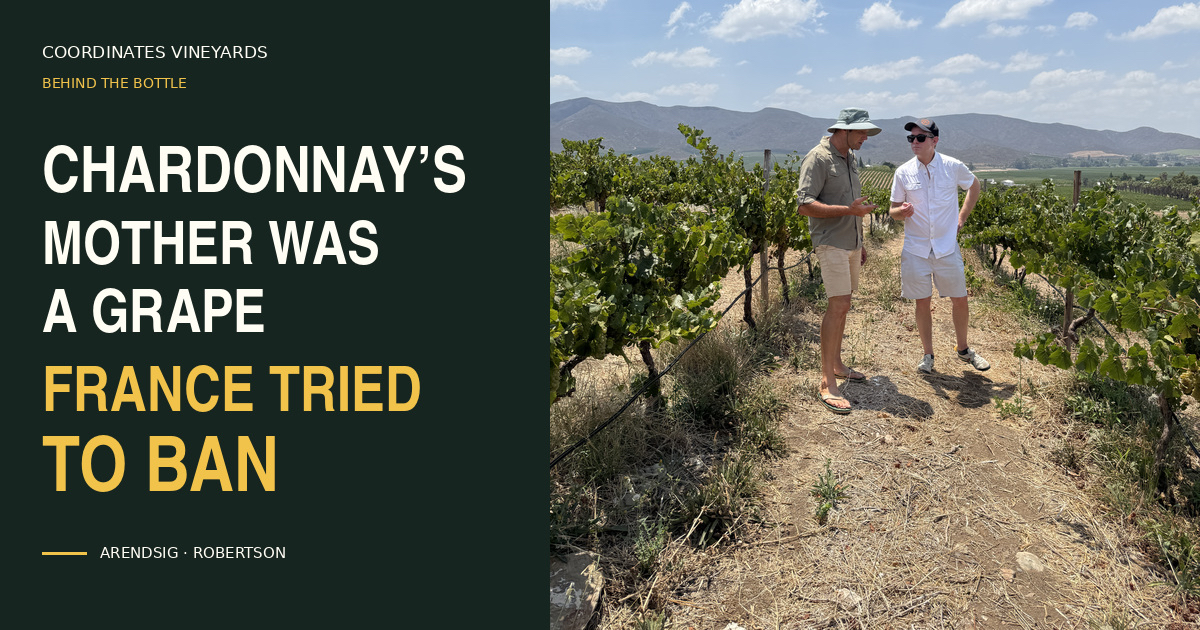
Now go south to Robertson, in South Africa’s Breede River Valley. This is where our Chardonnay comes from, and in January, Mahlon and I walked the vineyard that grows it.
We crossed one-lane bridges and drove dirt roads to Arendsig. Chardonnay covered the hill at the entrance, where the drive curves around toward the tasting room. We walked the rows and picked up stones from the ground: shale with pale, calcium-rich clumps mixed in. From the top of the hill, we could see the break in the mountain range that funnels the southeasterly wind into Robertson. The Cape Doctor was blowing steadily through it.
Arendsig is one you find by the coordinates.
Lourens van der Westhuizen is a fifth-generation farmer and the first in his family to make wine on the property. It is the same farm behind our Chenin Blanc. Walking his Chardonnay vineyard put something tangible behind the words on a bottle: stones in our hands, wind across the hill, and vines growing in both.
The calcium in Robertson’s soils has a story of its own. Jim Clarke at Wines of South Africa had told me about a connection with ancient termite nests. It sounded unlikely enough to look into. There is research behind the connection, though the termites identified in that research are a species still alive today.
Across parts of the Western Cape, termites are associated with broad earth mounds called heuweltjies, Afrikaans for “little hills.” Their activity concentrates plant material and nutrients and changes the soil’s chemistry. Over time, those conditions can help calcium carbonate accumulate. That is the same compound that makes up limestone, but here it can form within the soil as calcrete rather than as an ancient marine limestone bed.
Researchers studying vineyards in Robertson found strong carbonate accumulation in the mound soils and evidence of termite-associated carbonate formation. It is a local soil-building process, not proof that all Robertson’s lime came from termites. Water movement and the dry climate also matter. And holding a calcium-rich stone at Arendsig does not tell us, by itself, whether termites helped form that particular piece.
So the connection with Chablis is more interesting than simply saying both places have limestone. In Chablis, the story includes an ancient seabed and fossil oysters. In Robertson, carbonate-rich soils can also carry the legacy of tiny animals working through the land. Different histories, with consequences for the vines growing above them.
Robertson brings the other things a Chardonnay needs, too. Warm days help the grapes ripen, while cool nights and the southeasterly breeze help moderate the heat. The Breede River supplies irrigation water in this dry valley. When I think about our Chardonnay now, I picture that hillside and the wind coming through the mountains.
The day California won: Paris, 1976
For a long time, the wine world agreed on one thing about Chardonnay: the great ones came from Burgundy. Everyone else was making copies.
On May 24, 1976, a British wine merchant in Paris named Steven Spurrier set up a blind tasting to celebrate the American bicentennial. He put some of California’s best Chardonnays and Cabernets up against top white Burgundies and Bordeaux, and he invited nine French judges, people whose palates the wine world trusted completely. Only one reporter bothered to show up, George Taber from Time magazine.
When the scores were added up, the top white wine was the 1973 Chateau Montelena Chardonnay from Calistoga, Napa Valley. Six of the nine French judges gave it their highest score. A Stag’s Leap Cabernet won the red flight the same afternoon. Taber’s short article called it the Judgment of Paris, and the name stuck.
The details of that winning wine are better than the legend. It was made by Miljenko “Mike” Grgich, a Croatian immigrant who had come to California in 1958. The grapes came largely from young vines, which the French believed could not make serious wine. It was only the second Chardonnay the winery had ever released. It sold for about six dollars and fifty cents. And here is the part almost nobody mentions: Grgich blocked the malolactic fermentation. The wine that made California Chardonnay famous had none of the butter that California Chardonnay later became famous for.
A bottle of that 1973 now sits in the Smithsonian’s National Museum of American History. Grgich lived to be 100.
If you have seen the 2008 movie Bottle Shock, with Alan Rickman as Spurrier and Chris Pine as a young Bo Barrett, you know the dramatic version, including the scene where the Chardonnay turns brown after bottling and everyone panics. That part is stretched, but not invented. The wine really did go off-color for a short time after it was bottled, which happens more often than you’d think, and Grgich knew it would pass. “Bottle shock” itself is a real term for the way a wine can go flat and closed for a while after bottling or a long trip. The bigger liberty is that Grgich, the man who actually made the wine, was left out of the film. He chose not to take part.
Chablis, Robertson and California at a glance
| Chablis | Robertson (Arendsig) | California | |
|---|---|---|---|
| Where | Northern Burgundy, France | Breede River Valley, South Africa | Napa Valley and many other regions |
| Soil | Kimmeridgian limestone and marl with fossil oysters, about 150 million years old | Shale with calcium-rich clumps; carbonate can build up in termite-associated mounds | Varies widely |
| Climate | Cool, far north | Warm days, cool nights, southeasterly wind; irrigated from the Breede River | Often warmer sites |
| Cellar | Mostly stainless steel or old barrels | Our Chardonnay is lightly oaked | Often more oak; the 1973 Montelena blocked malolactic |
| Tastes like | Green apple, lemon, flint | Orange peel, roasted almonds, coconut and vanilla, bright finish | Often richer and riper; styles vary widely |
Butter, sunshine, and a backlash
What happened next is the story of a grape getting so popular that people got sick of it.
In 1982, a San Francisco lawyer named Jess Jackson made his first Chardonnay under a new label called Kendall-Jackson. One of the fermentations got stuck, which means the yeast quit before eating all the sugar. Experts couldn’t restart it. Jackson blended it in and released the wine a little sweet. It sold out. The 18,000 cases from that first vintage became a million cases a decade later, and the style that took over American shelves in the 1980s and ’90s was ripe, soft, oaky, buttery, and often a touch sweet.
Then came the backlash. Randall Grahm, the famously contrarian California winemaker at Bonny Doon, is usually credited with “ABC,” which first meant Anything But Cabernet. In the mid-1990s it turned into Anything But Chardonnay, and Frank Prial named the mood in the New York Times. In Britain, the same thing happened to cheap, oak-heavy Australian Chardonnay, helped along by a newspaper column, then a novel, then a movie about a single woman named Bridget Jones who drank a lot of it. The British wine critic Oz Clarke later said that before Bridget Jones, Chardonnay was really sexy.
Here’s the joke inside the backlash. A lot of people who swore off Chardonnay kept drinking Champagne, and Chardonnay is one of Champagne’s three main grapes. A Champagne labeled Blanc de Blancs, white from whites, is usually made entirely from it. Plenty of ABC drinkers were toasting with Chardonnay and never knew it.
The ABC crowd wasn’t rejecting a grape. They were rejecting a style. Which brings us back to the winemaker’s grape. If you have decided you don’t like Chardonnay, there’s a decent chance you’ve only met one kind of winemaker.
How the world actually drinks it
Chardonnay might be the most argued-over white wine in the world, and part of the fun is how differently people drink it.
In Burgundy, it’s dinner wine, served cool rather than cold, with chicken in cream sauce, fish, and cheese. The labels rarely say Chardonnay. They name the village.
In Chablis, it’s oysters, as we covered, and a plate of gougères.
In 1990s America, it was simply what “a glass of white wine” meant. Big, cold, and usually on its own.
In Saint-Tropez, they put ice in it. Locals and visitors on the Riviera have been dropping ice cubes into Champagne on hot afternoons since at least the 1960s. They call it a piscine, French for swimming pool. About fifteen years ago Moët & Chandon noticed and made a Champagne designed for it, with more sweetness built in to survive the melt.
So, can you put ice in your Chardonnay? We won’t call the wine police. On a 100-degree Hill Country afternoon on the porch, a cold glass beats a warm one every time. Just know what you’re trading. Ice chills the wine, but it also waters it down and dulls the aroma, and a delicate wine has the most to lose. A better trick is frozen grapes. They chill the glass without diluting it, and you get a cold grape at the bottom as a reward. Sangria-style fruit in a rich oaky Chardonnay mostly fights it. Save the fruit for a crisp, unoaked bottle or a sparkling one.
Temperature matters more than people think. Serve a crisp, unoaked Chardonnay or a sparkling one around 45 to 50°F. Give a fuller, barrel-aged Chardonnay a little more room, around 50 to 55°F. Straight from a cold refrigerator, a good oaked Chardonnay tastes like nothing at all. Pour it and wait ten minutes.
Throw a Chardy party
If you want to settle the ABC argument at your own table, here’s the most fun way I know. Call it a Chardy party.
Pour three Chardonnays side by side, with the labels covered. One crisp and unoaked, steel-fermented if you can find it. One barrel-aged. And one sparkling Blanc de Blancs. Invite at least one friend who swears they hate Chardonnay. Ask everyone to pick a favorite before you reveal what’s in the glasses.
Then put out food that lets each style show off. Oysters or shrimp for the crisp one. Roast chicken, crab, or anything in a butter sauce for the oaked one. Something salty and fried for the bubbles. And a big bowl of buttered popcorn, because now you know why that works.
The point isn’t to win the argument. It’s to find out which Chardonnay you actually like.
Our Chardonnay, and where it comes from
Which brings us to the bottle we pour.
Our Chardonnay is the single-vineyard estate wine from Arendsig, from the hill we walked that January. Lourens’s approach gives us a wine with enough richness for dinner and enough brightness to keep you reaching for another sip.
It’s lightly oaked, and you can taste every decision I described above. Orange peel, roasted almonds, and a long, bright finish with a hint of minerality. And coconut and vanilla, which you now know is the oak talking, the lactones and the vanillin from the barrel. It doesn’t taste like buttered popcorn. It tastes like a Chardonnay made by someone who wanted you to notice the fruit first. Our 2023 Chardonnay took Silver at both the 2026 Houston Rodeo Uncorked! International Wine Competition and the 2025–2026 San Antonio Stock Show & Rodeo competition, and you can explore the full medal record.
We also pour Chardonnay in a form a lot of people don’t recognize as Chardonnay. Our MCC Blanc de Blancs Reserve Brut is 100 percent Chardonnay from Paarl, made the same way Champagne is, with its second fermentation in the bottle. Taste it next to the still Chardonnay and you’re tasting one grape in two completely different lives. If you want the full story of how those bubbles get there, it’s in Nobody Was Drinking the Stars: How to Saber Sparkling Wine and Why It Works.
Come taste it
The best way to settle any argument about Chardonnay is to taste it side by side, with someone who can tell you what you’re tasting and why.
Reserve a tasting at our tasting room on Main Street in Fredericksburg or at the vineyard farmhouse in Hye on Highway 290, and ask about tasting the Chardonnay alongside the Blanc de Blancs. Bring the friend who says they hate Chardonnay. We’ll tell them about the peasant grape and the hillside we walked in Robertson. Then let the glasses do the talking.
Choosing wine for someone else? Explore our current gift collections for bottles to share around the table.
Go by the coordinates.
Frequently asked questions
What grapes are Chardonnay’s parents?
DNA research published by UC Davis in 1999 showed that Chardonnay is a natural cross between Pinot and Gouais Blanc, two grapes grown side by side in medieval northeastern France. A later study found Gouais Blanc was the mother.
Why do people call Chardonnay the winemaker’s grape?
Chardonnay has relatively few strong aroma compounds of its own, so its flavor depends heavily on climate and cellar choices like malolactic fermentation, oak aging, and lees stirring. The same grape can taste lean and citrusy or rich and buttery.
Why does some Chardonnay taste like butter?
The buttery flavor comes from diacetyl, a compound produced during malolactic fermentation, when bacteria convert sharp malic acid into softer lactic acid. Winemakers can encourage or limit it. Coconut and vanilla notes come from oak barrels.
What is the difference between Chablis and California Chardonnay?
Both are Chardonnay. Chablis comes from a cool region in northern Burgundy planted on fossil-rich Kimmeridgian limestone and is usually made with little or no new oak, so it tastes crisp and citrusy. Many California Chardonnays come from warmer sites and are often richer, riper, and more oak-influenced, though styles vary widely.
Does Robertson, South Africa have limestone soils?
Parts of Robertson have calcium-carbonate-rich soils, including calcrete. Research in Robertson vineyards has documented carbonate accumulation associated with termite mounds called heuweltjies. This differs from Chablis’s ancient marine limestone, and soils vary between vineyards.
What was the Judgment of Paris?
A blind tasting in Paris on May 24, 1976, organized by Steven Spurrier, where French judges ranked the 1973 Chateau Montelena Chardonnay from Napa Valley above top white Burgundies. The winemaker, Mike Grgich, blocked malolactic fermentation, so the winning wine was not buttery.
Can you put ice in Chardonnay?
You can. Ice chills the wine but dilutes it and dulls the aroma. Frozen grapes chill a glass without watering it down. Serve crisp Chardonnay at 45 to 50°F and oaked Chardonnay at 50 to 55°F.
Where can I taste Chardonnay in Fredericksburg, Texas?
Coordinates Vineyards pours a single-vineyard Chardonnay from Robertson, South Africa, and a 100 percent Chardonnay MCC Blanc de Blancs from Paarl at its Main Street tasting room in Fredericksburg and its vineyard farmhouse in Hye.